Showing posts with label egypt. Show all posts

Thursday, March 22, 2012

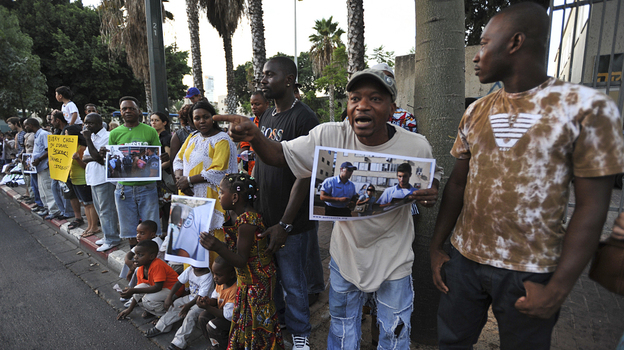
As (40,000) Illegal African Immigrants Increase, Israel Plans To Act


Egypt did not meet its obligations, and the UN concluded that Sweden had violated international conventions against torture since it was aware of Egypt's troublesome record on such matters. Israel's expulsion of 50 nationals of African countries to Egypt on Saturday may also be viewed as a violation of that same convention, in light of testimonies received in the past about the conditions of incarceration and the torture suffered by African asylum-seekers who were expelled to Egypt from Israel.
Attorney General Menachem Mazuz argues that Israel did not "expel" the refugees, but rather Israel "prevented their entry" into the country and is therefore not violating international accords.
According to international law, any person who crosses the border of a country and claims asylum, even if this person is not recognized as a refugee, is entitled to a hearing. 
International refugee law
 
International refugee law is a set of rules and procedures that aims to protect, first, persons seeking asylum from persecution, and second those recognized as refugees under the relevant instruments. Its legal framework provides a distinct set of guarantees for these specific groups of persons, although, inevitably, this legal protection overlaps to a certain extent with international human rights law as well as the legal regime applicable to armed conflicts under international humanitarian law.
The main sources of refugee law are treaty law, notably the 1951 Convention relating to the status of refugees (1951 Refugee Convention) and its 1967 Protocol, and customary international law. Customary international law applies to all states irrespective of whether they are a party to relevant treaties or not. Regional instruments represent a further set of protections, particularly the 1969 Organization of African Unity Convention (for Africa) and, although it is not formally legally binding, the 1984 Cartagena Declaration (for Latin America).
The Definition of a Refugee
International legal protection of refugees centres on a person meeting the criteria for refugee status as laid down in the 1951 Refugee Convention. Under Article 1(A)2, the term “refugee” shall apply to any person who:
“...owing to well-founded fear of being persecuted for reasons of race, religion, nationality, membership of a particular social group or political opinion, is outside the country of his nationality and is unable or, owing to such fear, is unwilling to avail himself of the protection of that country; or who, not having a nationality and being outside the country of his former habitual residence as a result of such events, is unable or, owing to such fear, is unwilling to return to it.”
Thus, according to this provision, refugees are defined by three basic characteristics:
  • they are outside their country of origin or outside the country of their former habitual residence;
  • they are unable or unwilling to avail themselves of the protection of that country owing to a well-founded fear of being persecuted; and
  • the persecution feared is based on at least one of five grounds: race, religion, nationality, membership of a particular social group, or political opinion.
It is important to stress that the term “asylum seekers” refers to persons, who have applied for asylum, but whose refugee status has not yet been determined.    


The place is Tel Aviv, but it doesn't look at all like Israel: Dozens of African men are sitting on broken stools and plastic at a makeshift restaurant.
Sudanese fare is on the menu. The men scoop up the stews and salads that remind them of home.
Abdullah Mohammad Mustafa started this restaurant with a couple of other African men who arrived in Israel five years ago from Sudan's troubled Darfur region. They are among some 40,000 Africans who have come to Israel illegally, and many have congregated in neighborhoods in Tel Aviv.
Mustafa is among the many Africans and Asians who have been arriving in Israel in recent years, and most have been sneaking across the country's porous southern border with Egypt.  


Israel is now taking a series of steps to stop the influx and reverse the flow. This summer, Israel will begin deporting those who agree to leave voluntarily. Other parts of the plan are still under construction — like a 150-mile fence being built along the border with Egypt. And there will also be a massive detention center.
"Like many other countries in the world, Israel faces a serious problem with illegal immigration," says Josh Hantman, a spokesman for Israel's Defense Ministry. "Israel always has to find the most humane way of dealing with this tricky issue."
He says the detention center, which will be completed later this year, will have spacious rooms, computers and a sports center. Detainees will have access to lawyers and health care.
By the end of this year, Israeli officials say, the facility will be able to hold several thousand people. By the time it is fully built, it will have a total capacity of 11,000 people — making it one of the largest detention facilities in the world.
"We see from other countries that the effect of detention centers on asylum seekers that went through trauma in their home countries, or on their way to Israel, will be very harmful for their health, both mental and physically," says Shachar Shoham, the director of the Migrants Department at Physicians for Human Rights.
Shoham says Israel already has a policy of detaining some of the people who enter the country without permission. Up until now, they've been sent to Ketziot, a sprawling prison in southern Israel.more from Npr


Monday, December 19, 2011

Egypt’s richest Library established in 1798 by Napoleon set on Fire

This is horrible that all of this wealth of information and knowledge has been damaged or destroyed. Shera~


CAIRO- The 213-year-old Egyptian maps and historical manuscripts — described as “irreplaceable” — were destroyed after a library in Cairo was set ablaze during the clashes, Egyptian officials said Sunday.
A fire that engulfed the building of the historic Egyptian Scientific Institute on Saturday morning has been extinguished. The extent of the damage has not yet been determined.
The fire started on the lower floors of the building, which is on Qasr al-Aini Street in central Cairo, but later reached the higher floors. The firemen, who arrived very late at the site, could not initially control the fire.
Eyewitnesses were reported to have seen protesters throwing a Molotov cocktail at stone-throwing soldiers at the Shura Council building, but the projectile missed the intended target and instead landed in the Egyptian Scientific Institute.
The website of Youm7 newspaper alleged that a protester was set on fire after trying to set the building on fire. No other source confirmed this news.
The institute is considered the oldest scientific institute in Egypt. It was established as L’Institute d’Egypte in August 1798 by Napoleon Bonaparte during the French invasion of Egypt.


THE POLYTECHNIC LEGACY


for the ASME Management Training Workshop, Sheraton Dallas Brookhollow Hotel, Dallas TX,
9:30 AM, Saturday, August 22, 1998


by John H. LienhardMechanical Engineering Department
University of Houston
Houston, TX 77204-4792
jhl@uh.edu
Every now and then, it’s worth any group’s time to take stock of who they are and where they came from. So, who are we and where did we come from? Who are we who’ve been calling ourselvesengineers since the early 19th century?
Actually, so much of who we are and what we do traces to what I call The Legacy of the Polytechnic Institute. To explain that, I first need to play with the word engineer. Engineers have been around a long time. Whoever organized construction of the Great Pyramid five thousand years ago richly deserves to be called an engineer. But the term engineer has been generally used only since people started learning how to build things in universities. Before that, most of the great inventors and builders did their work without formal education. Young James Watt spent a year in London as an apprentice instrument maker. The rest he had to get from conversation, reading, or his own invention. But as we trace the etymology of the word engineer, we find that it’s grown up around the formation of schools meant to teach us how to make things.
The word engineering probably derives from the Latin word ingeniatorum. In 1325 a contriver of siege towers was called by the Norman word engynours. By 1420 the English were calling a trickster an yngynore. By 1592 we find the word enginer being given to a designer of phrases — a wordsmith. The Oxford English Dictionary gets to the first use of the modern word engineer in 1635, but you might not be crazy about its use. Someone is quoted as calling the devil — “that great engineer, Satan.”

Its mission is to advance high quality research in various fields, ranging from biology and mathematics to fine arts and archaeology. Its library contains more than 200,000 books, including the original volumes of the “Description de l’Égypte” (Description of Egypt), begun in 1798 by French scientists in Egypt.
thank you Winter Lake

Short URL: http://www.newsnet14.com/?p=90320

Tuesday, April 13, 2010

Greco-Roman mummy, tombs uncovered in Egypt oasis

CAIRO (Reuters) – Egyptian archaeologists carrying out excavations at the site of a planned youth center have found 14 tombs dating back to the third century BC, including one with a female mummy adorned with jewelry.
The Greco-Roman tombs, in Bahariya Oasis, 300 km (190 miles) southwest of Cairo, were discovered during probes that indicated they may be part of a much larger necropolis, Egypt's Culture Ministry said in a statement Monday.

A 97-cm (38-inch) tall female mummy, found in the stair-lined interior of one of the rock-hewn tombs, was cast in colored plaster inlaid with jewelry and eyes.
Archaeologists, who dug at the site ahead of the planned construction of a youth center, found the tombs contained other treasures as well. The area has now been turned over to Egypt's antiquities authority.

Wednesday, March 10, 2010

Quebec woman barred from course for second time. . .


The Egyptian immigrant made headlines last week when it was revealed provincial Immigration Department officials expelled her from a government-sponsored French class several months ago after she refused to take off her niqab.
Known only as Naema in Quebec media, she had since enrolled in another government-sponsored French class, this time at a community centre for immigrants in Montreal.  But almost as soon as the Quebec government got word she was attending class in her niqab, it confronted her again, forcing her to make the same decision she made in November.
As she did then, Naema chose her religion instead of learning French on the Quebec government’s terms.
“It is a copy and paste of what happened last week,” said Samer Majzoub, who heads the Canadian Muslim Forum, a non-profit organization that has been providing support for Naema.
“Why is the government doing this? I wonder if they have other things to do in life other than following this woman.”
Quebec Immigration Minister Yolande James appeared to move quickly in addressing the latest contribution to the province’s ongoing debate over the accommodation of religious and ethnic minorities.
News of Naema’s new enrolment first appeared in Tuesday’s edition of Montreal La Presse newspaper. By 10 a.m., officials from the Quebec government were meeting with her and representatives of the centre.
James’ office said it received word on Friday from teachers at the community centre that Naema was wearing her niqab in class.
“As we did last time, we told her that we have pedagogical objectives to meet in our French immersion courses, that they have to be taken with her face exposed,” said Luc Fortin, a spokesman for James.
“She refused to take off her niqab and she left the course.”
In Quebec City on Tuesday, James said “if she wants to attend the classes we need to be able to see her face.”  Naema declined to speak to The Canadian Press, saying through an intermediary that she had been upset by media coverage of her initial expulsion.
Several commentators as well as certain Muslim groups expressed support for the Quebec’s government’s position last week.  They argued Naema had been unreasonable in her demands, which reportedly included giving oral presentations with her back facing the co-ed class.
“She’s devastated,” Majzoub said. “This woman was insisting on being part of Quebec society, on integrating.”
The accommodation issue is politically contentious for the provincial Liberal government.  Facing repeated criticism from the Opposition Parti Quebecois for failing to protect Quebec values, the Liberals say they intend to take “concrete measures” in the coming weeks to deal with the problem.
More from source
thank you battleskin