
Showing posts with label ohio. Show all posts
Showing posts with label ohio. Show all posts
Tuesday, August 22, 2023
Have You Ever Wondered Where Your Next Meal was coming from? Where is the HUMANITY!?!?!?


Thursday, July 6, 2023
PSA: Giving Everyone A Heads Up about a Dirty Ohio State Highway Trooper
"GIVING EVERYONE A HEADS UP, MY OL MAN GOT PULLED OVER FOR DOING 5 MILES OVER THE SPEED LIMIT IN LONDON OHIO, BY OHIO STATE TROOPER CRYSTAL R JONES, AND SHE SAID THAT MY OL MAN HAD OVER 3GRAMS OF COCAINE , WHICH HE NEVER HAD, AND HAS NEVER CAUGHT A POSSESSION CHARGE IN HIS LIFE, CASE GOT DISMISSED BECAUSE OF A DIRTY STATE TROOPER IN OHIO. BLATANLY LIED, NOW IF SHAWN R OBBAGY WOULD HAVE GOT CAUGHT LYING THAT WOULD HAVE BEEN A FELONY, NOW IS THIS HOW OHIO STATE TROOPERS ACT?
THIS ONE HAS HAD 12 DIFFERENT PHONE NUMBERS AND 24 DIFFERENT ADDRESSES. MY OL MAN HAS HAD 2 PHONE NUMBERS AND 3 ADDRESSES IN THE PAST 30 YEARS. BUT WANT TO HEAR SWEET JUSTICE COME FROM THE JUDGES MOUTH OF CASE DISMISSED AS WE WHERE TOLD BY THE PUBLIC DEFENDERS SECTARIES MOUTH IN A VOICE MAIL SHE LEFT ME EARLIER TODAY. Please share the heck out of this


Friday, June 3, 2022
8 yr old Girl KRUSHES "Freak on a Leash" by Korn (v2/2) / O'Keefe Music ...
OMF is a non-profit music organization based in Ohio, USA, with a mission to provide high quality music education to any child in the world for FREE! Why? Because art gives voice to our dreams and live music performance is becoming a dying art. Since 2006, OMF has helped over 1000 students make countless music videos… with over 80 million combined YouTube views!
You can read more about us on our website, view other great music vids, and even apply to be an OMF rockstar (as long as you are 18 or under)! You can also buy some cool merch, or support us in recording more great songs and videos in the future.
Special Thanks Goes Out To:
To all our donors for their continued support!
And to the OMF parents, students and crew!
Monday, February 17, 2014
Finally and Who would have thought? smh in disgust; Somali fraudsters exposed in Lewiston, ME and Columbus, Ohio
Posted by Ann Corcoran on February 1, 2014

Monday, November 11, 2013
HB 203 (Concealed Carry & Self-Defense Law Reform) scheduled for third hearing in House
Submitted by cbaus on November 11, 2013 - 4:00pm.
Chairman Mike Dovilla has announced that the Policy and Legislative Oversight Committee will be hearing proponent and opponent testimony on Representative Terry Johnson's (R-McDermott) HB 203 this Wednesday, November 13 at 9:30 a.m. in Statehouse Room 115. This will be the third hearing for this important bill.
Any persons who are interested in testifying are welcome to contact Jim Irvine (jirvine@BuckeyeFirearms.org) for help in preparing and coordinating your testimony.
Buckeye Firearms Association has previously testified in support of the bill.
HB 203 seeks to make many improvements to Ohio's concealed carry laws.
The bill would strengthen the background checks required to obtain an Ohio Concealed Handgun License (CHL). Under the bill, Ohio concealed handgun license (CHL) applicants would be a National Instant Check System (NICS)-compliant background check, making it compatible with more states. This improvement will also help prevent people with mental health disqualifiers who have been entered into the federal database from obtaining a CHL.
The bill would also move Ohio to an automatic reciprocity system, relieving the Attorney General from needing to sign agreements with every state to facilitate reciprocity. The Attorney General would still be permitted to sign agreements if needed, but the bill seeks to streamline the process and open up agreements with states like Indiana, Pennsylvania, and Georgia that Ohio doesn't currently have agreements with.
The bill would also update the requirements and disqualifications to obtain an CHL. Currently there are different standards to possess a gun under federal and state law, and different still to obtain a CHL. HB 203 harmonizes Ohio law with federal law so that someone who is prohibited under federal law from possessing a firearm will not be issued a CHL. Ohio would also be able to issue licenses to out-of-state residents, something many other states already do.
Under the bill, the current topics required for Ohio CHL training would remain, but the mandate that an instructor spend 12 hours covering the topics that can be covered adequately in less time would be reduced to four hours.
Finally, HB 203 seeks to modify the state's self-defense law. Current law specifically states that a person has no duty to retreat before using deadly force if that person is in their own home or automobile. HB 203 would expand that to anyplace that a person lawfully has the right to be. more from buckeyefirearms
Thursday, October 10, 2013
Come on Ohio, what is it with HS Football Players and Rape? Circleville High School Football Players Face Charges Over Sex Recording | WBNS-10TV Columbus, Ohio
Circleville High School Football Players Face Charges Over Sex Recording | WBNS-10TV Columbus, Ohio
CIRCLEVILLE, Ohio - Two male students at Circleville High School are facing charges over an alleged sex video they made involving a 14-year-old girl.
The teens, ages 17 and 18, are each charged in juvenile court with one count of pandering obscenity involving a minor.
The teens, ages 17 and 18, are each charged in juvenile court with one count of pandering obscenity involving a minor.
According to Circleville Schools Superintendent Kirk McMahon, the two individuals are football players.
Another player on the team reported hearing about the video and reported it to an assistant coach on Sept.13. The assistant coach told the head coach, who went to school officials, according to McMahon.
Another player on the team reported hearing about the video and reported it to an assistant coach on Sept.13. The assistant coach told the head coach, who went to school officials, according to McMahon.
The school resource officer and police chief launched an investigation, which was completed on Sept. 25, when charges were filed.
The school was asked by authorities to wait on their internal investigation until the police investigation was complete.
The school was asked by authorities to wait on their internal investigation until the police investigation was complete.
“At that point the police asked us not to investigate on the school side yet as to not interfere with the police investigation,” said McMahon.
McMahon said the district was informed of the charges on Monday and have now launched their internal investigation.
It's not known what discipline the students will face from the school.
It's not known what discipline the students will face from the school.
Wednesday, July 18, 2012
Threats to neighborhoods can become positive catalyst
Threats to neighborhoods can become positive catalyst


The Historic Village of Zoar has been named to the 2012 list of America’s 11 Most Endangered Historic Places®

Many consider German Village a kind of urban sanctuary -- an historic oasis with a view of downtown, a neighborhood that provides both a step back in time and all the creature comforts of the 21st century.
We have parks that reflect our appreciation for beauty and culture and historic brick streets that we know generations of feet have tread upon before us.
German Village is a sigh of relief, a breath of fresh air and a place wholly different from the rest of downtown.
We pay homage to our forebears with our name -- we are called "German Village" for the Germans who came before us.
And we celebrate the successes those Germans worked so hard for and enjoyed so deservedly in Columbus city government, the brewing and publishing industries, and the field of education among so many others.
German Village, a small pocket of the old "South End," was settled by Germans who wanted to succeed in America and who ultimately became the very image of Americans pulling themselves up by their bootstraps.
Ohio and the Midwest have many communities like German Village (sort of ... there really isn't anywhere like German Village, right?) but there is one community in particular that is clinging to hope for a future as storied as its past.

The Village of Zoar in Tuscarawas County was recently included on the National Trust for Historic Preservation's "America's 11 Most Endangered Historic Places" list.
This is big news, but those living in Zoar are celebrating -- they are hopeful that this listing will bring more attention and new ideas about how to save the community.
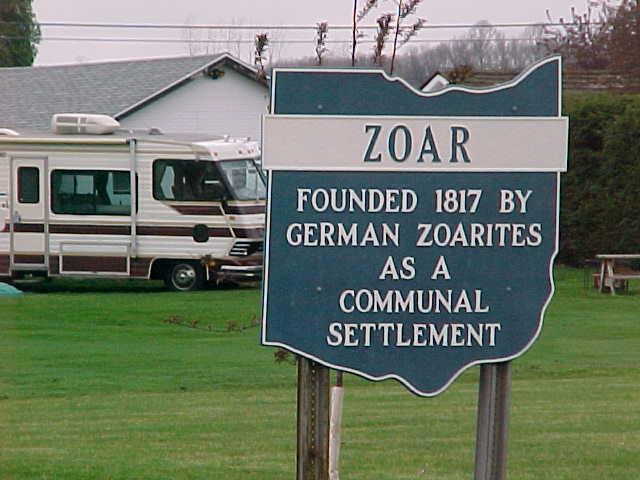
The Village of Zoar was established in 1817 by German separatists. It was by all accounts a successful experiment in communal living that lasted until 1898 when the Society for the Separatists of Zoar disbanded.
It was so very different from our German enclave growing south of Columbus, though there are similarities in the determination of the Germans, the high quality of the goods and educational services they produced and which were sought by others, and the sense of community that made the village prosper.
Today the village is protected by a levee that is failing. The U.S. Army Corps of Engineers built the levee in 1936 and this year, the Corps gave the levee its lowest safety rating.
The Historic Village of Zoar has been named to the 2012 list of America’s 11 Most Endangered Historic Places®
The National Trust for Historic Preservation has identified the Village of Zoar, OH as an important historic site that is at risk. The Village sits at the base of a levee constructed by the U.S. Army Corps of Engineers (USACE) nearly 75 years ago to hold back potential floodwaters. The levee is in need of major repairs. By being named to the list of “America’s 11 Most Endangered Historic Places” the historic Village of Zoar moves into a national discussion. The additional attention generated through this designation by the NTHP is expected to encourage more people to learn about Zoar and to become supporters of saving the village.
The historic village on the Tuscarawas River is listed on the National Register of Historic Places. It tells a unique story of a group of German immigrants escaping religious persecution to establish a commune in 1817. Descendents of original founders continue to live in some of the historic homes. It is an easy stroll through town to visit shops, the beautiful garden in the center of town, and to see original homes, the school, the hotel, and more.
The Federal government is required to consider all options to fix the problem and the options are whittled down to: repairing the levee to the tune of $100 million, demolishing the village and letting the area flood, or relocating the village to higher ground.
Can you imagine those options being asked of German Villagers today?
German Village has a long history of working with the government, though thankfully not to this extent.
In many ways, the government gets credit for our very existence. If the Federal Highway Administration and ODOT hadn't decided to construct Interstate 70 through Columbus, severing our seamless connection to downtown, local residents might not have noticed this piece of the South End was worth saving.
Those locals might never have felt a need for a German Village Society. They might never have worked so hard to have German Village become the first historic district in Columbus, and there might not have been an architectural review commission that subsequently helped property values skyrocket and preserv ed historic structures, pieces, and parts.
Yes it breaks my heart to think of the blocks of brick homes, businesses and churches that were demolished to make way for I-70 -- we lost the northern third of what was then considered the South End.
But if losing those blocks helped create and save the German Village we are so fortunate to enjoy and learn from today, then it must have been worth it.
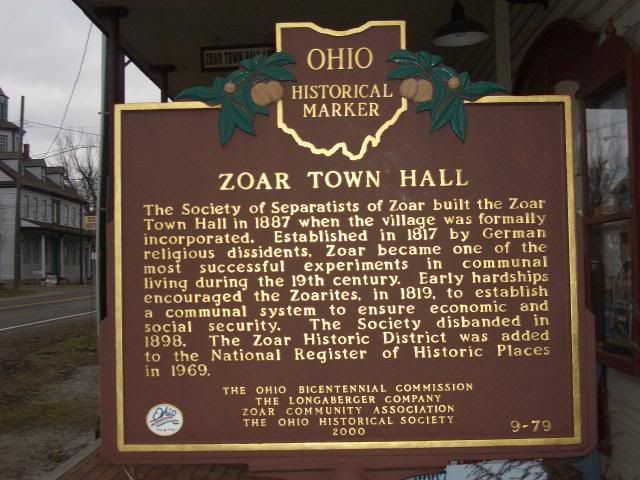
The residents of Zoar have an uphill battle ahead of them, but I think they are looking at this challenge in the right way.
They aren't ashamed of their inclusion on this list -- they are relishing it for the good they hope it will bring.
We thought we had an uphill battle when I-70/71 was to be reconstructed, and while we were given the gift of time, that is a challenge the future Villagers will surely face.
Thankfully we have 50-plus years of civic-mindedness and successes to keep our momentum going and thinking caps firmly in place.
Those who love living in old houses, who love living downtown, who love living somewhere unique, always seem to have to jump a few extra hurdles, but I suppose that's what makes the lives we choose so worthwhile.
If you're looking for a day trip, go visit Zoar. The name means "sanctuary" and for 200 years it has given that to its residents and many a visitor.
Support their local businesses as you do ours and let them count you as one of their many visitors for the year.
They need our support and as fellow preservationists, it's our job to give it to them.
Besides, you never know when German Village will need support from other preservation-minded citizens.
Let's just hope it isn't anytime soon. To learn more, please visit http://www.savingplaces.org/treasures/village-zoar.
German Village Society Historic Preservation Officer Jody Graichen submitted the Village Notebook column to the ThisWeek German Village Gazette.
Wednesday, February 22, 2012
Ohio sends hundreds of millions in gas-tax money to other states and what exactly is a HTF?
Ohio might not face such lengthy delays in sorely needed highway upgrades if the state received a better return on the money its residents pay in federal gasoline taxes.

Ohio residents contribute a bigger share each year to the federal fund that pays for transportation improvements across the country than their state has ever received back. The gap cost Ohio $140.5 million in fiscal 2010, the last year for which the Federal Highway Administration calculated state-by-state spending and tax collections.
Ohio has lost out on $1.5 billion over the past decade and on more than $5 billion since the Federal Highway Trust Fund was created in 1956. The agency has promised too much in the past and isn’t able to deliver in a time of declining gas consumption and rising construction costs, Wray said.
Financing Federal-Aid Highways
The Highway Trust Fund
The previous sections have only peripherally mentioned the Highway Trust Fund (HTF). This has been intentional. The fact that the HTF is the source of funds for the Federal-Aid Highway Program (FAHP) has a limited impact on the financial procedures under which the highway program operates. The use of the Trust Fund provides two direct benefits to the highway program: (1) It allows the program to operate with contract authority through the 1974 Budget Act, and (2) it provides the opportunity for revenue aligned budget authority (see discussion under "Appropriations"). The following section briefly describes the operation of the HTF.
History
Before 1956, the year Interstate System authorizations were greatly increased, the HTF did not exist. Cash to liquidate previously incurred obligations for the FAHP came from the General Fund of the Treasury. Budget authority came through the granting of contract authority, as it does now. Although taxes on motor fuels and automobile products were in existence, they were not linked to funding for highways. At the time, financing for the highway program and revenues from automobile and related products were included under the public finance principle of "spend where you must, and get the money where you can." Aside from this, the program operated in terms of authorizations, obligations, appropriations, and reimbursements—much as it does now.
The Federal-Aid Highway Act of 1956, coupled with the Highway Revenue Act of that same year, increased authorizations for the Federal-aid Primary and Secondary Systems, authorized significant funding of the Interstate System, and established the HTF as a mechanism for financing the accelerated highway program.67 To finance the increased authorizations, the Revenue Act increased some of the existing user taxes, established new ones, and provided that most of the revenues from these taxes should be credited to the HTF. Revenues accruing to the HTF were dedicated to the financing of Federal-aid highways. The passage of the Highway Revenue Act of 1956 also increased the political acceptability of the additions in the user taxes and provided earmarked revenues to finance the larger highway program.
The imposition of the taxes that are dedicated to the HTF, as well as the authority to place the taxes in the HTF and to expend from the HTF all have expiration dates which must be extended periodically. The 1956 Highway Revenue Act provided for the imposition of the taxes that support the HTF through June 30, 1972, and the transfer of such taxes and the payment of refunds through June 30, 1973. Expenditures from the HTF were authorizedthrough June 30, 1972. The life of the HTF has been extended several times by subsequent legislation, most recently by the TEA-21, which extended the imposition of taxes through September 30, 2005,68 and the transfer of the taxes to the HTF and the payment of refunds through June 30, 2006. The TEA-21 authorized expenditures from the HTF through September 30, 2003.
User Taxes
The HTF was created as a user-supported fund. Simply, the revenues of the HTF were intended for financing highways, with the taxes dedicated to the HTF paid by the users of highways. This principle is still in effect, but the tax structure has changed since 1956.
In addition, since fiscal year 2007, nearly $30 billion in subsidies to the federal highway fund have ensured that every state gets back at least one dollar for every dollar it sends to Washington in gas taxes. Ohio drivers have paid almost $8.6 billion in federal gas taxes since 2004, and the state has received nearly $9.8 billion back.
But the funding formulas before subsidies have created a substantial gap between donor states and “donee” states, which get a bigger share back from the federal fund than their residents pay into it through gas taxes.
Alaska has received a share of the trust fund that’s $8.5 billion bigger than Alaskans’ gas-tax contributions through the years would warrant..
In contrast, Texas has received $13.6 billion less. Ohio’s gap is the fourth-largest.
The states on the winning end typically are sparsely populated and geographically large. They include Alaska, Montana, Wyoming and the Dakotas.
States on the losing end — Texas, California, Florida, Ohio and Michigan fare the worst — tend to be among the most populous.
Federal officials say gas-tax money has been pooled since the 1950s because of the need for a national highway system built to a uniform standard. A shift of money was needed because the construction timetable varied from state to state. It also ensured that interstates didn’t suffer or go unconstructed in states with smaller populations. more
Saturday, December 24, 2011
Fruitcake purchased at Kroger's in 1941 sells at auction in Ohio
Whether you love it or hate it, there is almost always a fruitcake at every Christmas party.

It is hard to ignore the rum-filled dessert packed with candied fruit, nuts and spices that often sits uneaten in the corner of the dessert table. But one that just sold in the U.S. would definitely have people talking if it were sitting on the corner of your table.
A man in Ohio has auctioned one off made in 1941 for $525. Meaning it was made when William Lyon Mackenzie King was Prime Minister and Canada was fighting in WWII.
E.F. Helbing purchased the dessert in 1941 and after 30 years decided to return it to the store at which he bought it. He returned it with a note dated May 20, 1971 that reads, "This fruitcake is one of six purchased by the undersigned during Christmas Week of 1941. During its 30 years of life the cake has traveled thousands of miles and has been subjected to all types of climatic conditions and shocks. We are moving again and wish to return the cake to its makers - THE KROGER COMPANY."

Store manager Frank Bates couldn't throw the cake out so he kept it, reports News10/KXTV. Frank's son, Wally, recently found the cake while helping his dad, now 86 years old, clean his house and they decided to auction it off with all of the proceeds going toward charity.
"As part of our support to the needy in our area we are privileged to offer this rare and unique collectible genuine and documented 1941 Kroger's Fruitcake," reads the Elite Estate Group website, which auctioned off the cake. "This neat old tin has the original label and most of the original box."
Larry Chaney of Elite Estate Group told WCPO it is in the old vacuum packed with rum and while it may have some rust on it, it's still probably pretty good.
But he called Kroger to advise them of the ancient snack and they told him to tell the buyer to keep it for a conversation piece and not for eating.
Sunday, September 18, 2011
What are these spores? Help Please If You Can?!
What are these spores? Help Please If You Can?!

Went to plant tulip bulbs in the ground and these spores or whatever they are where there and We've never seen anything like it.

Saturday, July 16, 2011
'My Name is Earl', Look alike Charged with 2 Counts of Animal Cruelty in Bestiality Case as it is not illegal in the state of Ohio
ANIMAL WELFARE/TAKE ACTION/VIDEO) OHIO — An Ohio man is accused of sexually assaulting a female dog whom he recently adopted from a shelter along with two other dogs and possibly even a horse. Bestiality is not illegal in the state of Ohio, so the man is charged with only two misdemeanor counts of animal cruelty. While this man obviously needs psychiatric care of some sort, so do most sexual predators of the human kind. Nothing takes advantage of an animal’s innocence more than this crime, so let’s treat it like a real crime.


This case inspired a petition to protect animals by making bestiality a felony in Ohio. The petition needs signatures, so please sign it and spread the word! — Global Animal


Peter Bower of Shelby, Ohio, was arrested on May 18th, 2011, and charged with two counts of animal cruelty after allegations that he had sex with three companion dogs and possibly a horse owned by a local equestrian center. KAIT 8 News reported that during a police search of his home, photos of Bower having sex with animals were discovered, as well as online postings of his acts found on his computer. Authorities also found a book on bestiality and a plastic, blowup sheep. Another scary detail is that Bower advertised dog walking and sitting services in his neighborhood and at his local animal shelter.
Despite the absolute heinousness of these alleged actions, Bower is only facing misdemeanor charges, as Ohio has no first-offense felony animal cruelty laws, nor any separate laws specifically prohibiting the sexual assault of animals. But this case has gained much attention and has led some to act. “If this had been a child, there would have been an uproar about it,” concerned citizen Joyce Fields told the Mansfield News Journal. “There isn’t much difference because this pet didn’t accept or consent to what he was doing.” Fields has started a petition, along with a local animal advocacy group, seeking to expressly outlaw the sexual assault of animals. Fields hopes that Ohio will pass a law to coincide with the 36 other states that already have laws prohibiting such acts, separate from other forms of animal cruelty. Response to the action has been swift, as State Rep. Jay Goyal has said recently that his office is already working on a draft of such legislation.
Fields also started an additional petition in which she seeks to bar Bower from owning or interacting with any animals, and she will present it to the prosecutors and judge at Bower’s pretrial hearing on July 18th. In addition, authorities are looking into whether charges can be brought against Bower for disseminating pornography.
Tuesday, February 22, 2011
Protest of SB 5 in Columbus Ohio and Doors To The State House Locked
Ohio Statehouse locked amid union protest
COLUMBUS, Ohio (AP) -- Democratic legislative leaders in Ohio said Tuesday that they were prepared to ask a judge to force officials to unlock the doors to the Statehouse as thousands of union protesters gathered for a hearing on a bill that would strip public employees of collective bargaining rights.
Ohio Public Safety spokesman Joe Andrews says about 1,000 people have been allowed into the Rotunda and Atrium for a committee hearing on the bill and additional visitors without appointments were turned away in the interest of safety. The heightened security came after a long President's Day weekend during which unions across the state sought to mobilize their supporters against the bill and bring out big crowds.
Visitors wanting to attend the hearing after doors were closed were directed to an off-site theater, where the meeting was to be simulcast.
The bill, sponsored by first-term state Sen. Shannon Jones, a Cincinnati-area Republican, would end collective bargaining rights for state workers and restrict teachers, firefighters, police, university employees and local workers in their bargaining abilities. Protect Our Protectors, a newly formed coalition of police and fire unions, urged the Ohio Senate to slow down action on the bill, which has been drawing crowds to the Statehouse for several weeks. Senate Democratic Leader Capri Cafaro sent a letter asking the chamber's Republican leaders to schedule more hearings before a vote that is expected as early as this week. Kasich, Jones and other supporters of the measure say it could help control spending and provide more flexibility for cash-strapped governments to negotiate with employees. Witnesses in favor of the bill have included local government leaders and schools superintendents who said public employee unions have too much power under the current system.
The bill, sponsored by first-term state Sen. Shannon Jones, a Cincinnati-area Republican, would end collective bargaining rights for state workers and restrict teachers, firefighters, police, university employees and local workers in their bargaining abilities. Protect Our Protectors, a newly formed coalition of police and fire unions, urged the Ohio Senate to slow down action on the bill, which has been drawing crowds to the Statehouse for several weeks. Senate Democratic Leader Capri Cafaro sent a letter asking the chamber's Republican leaders to schedule more hearings before a vote that is expected as early as this week. Kasich, Jones and other supporters of the measure say it could help control spending and provide more flexibility for cash-strapped governments to negotiate with employees. Witnesses in favor of the bill have included local government leaders and schools superintendents who said public employee unions have too much power under the current system.
Thursday, November 4, 2010
Ohio Congressional Candidate, (R) Rich Iott, Loses To U.S. Rep. Marcy Kaptur (D-Toledo)
 | |
| Iott |
So this is all coming down to Iott, being involved in WWII re-enactments. . . Voters want to use that as a reason for not voting for Iott. I'd say the Democratic Party and Media made Mr. Iott's love and passion for History his downfall.
'He claims it is just a pure love of history and amazement at the success of the Third Reich.
“I’ve always been fascinated by the fact that here was a
relatively small country that from a strictly military point of view
accomplished incredible things. I mean, they took over most of Europe
and Russia, and it really took the combined effort of the free world
to defeat them. From a purely historical military point of view,
that’s incredible,” said Iott.
History is a great thing. Iott should not be criticized for
his passion for it, but some people think his interest is misdirected.'
Kaptur led Iott with 110,542 votes, or 59 percent. Iott had received 78,150, or 41 percent. Kaptur's win will send her to Washington to serve a 15th term in the U.S. House of Representatives.
 | |
| Kaptur |
During her campaign, Kaptur railed against Iott's participation in historical Nazi military re-enactments and his selling of an Ohio company his father founded to a large retailer who later closed the business.
Many republicans, including Eric Cantor, of Virginia, the No. 2 Republican in the House, criticized Iott for the military re-enactments.
Many republicans, including Eric Cantor, of Virginia, the No. 2 Republican in the House, criticized Iott for the military re-enactments.
Kaptur also hammered the big banks, which she said have really hurt middle America during the last several years.
"I have no sympathy for them," she said last week.
In Ottawa County, Kaptur received only 48.1 percent of the votes, with 7,705, while Iott garnered 7,964, or 49.7 percent. But in Erie County, Kaptur took 52.6 percent with 14,347 votes. Iott took 47.38 percent with 47.3 percent.more
Tuesday, September 7, 2010
Texas: ATS Labels Anti-Traffic Camera Initiatives Racist
Traffic camera firm invokes 1965 civil rights bill to stop votes in Baytown and Houston, Texas that would ban red light cameras.
The citizen-led groups that want the public to decide the future of red light cameras are racist, according to lawsuits filed by American Traffic Solutions (ATS) in a pair of Texas cities. The Arizona-based photo enforcement firm filed in a state court in Baytown on Thursday and then an ATS-funded front group filed an identical case in a federal court in Houston on Friday. Residents in both cities signed petitions placing a ban on automated ticketing machines onto the November 2 ballot, but ATS cites the landmark Voting Rights Act of 1965 as a reason to block these votes.

“Because the camouflaged referendum has been improperly placed on the ballot, a potential for racial discrimination exists,” Houston lawyer Andy Taylor wrote on behalf of ATS. “More specifically, minority voters may lose their ability to elect candidates of their choice in local, statewide and federal offices.”
The ATS claim may come as a surprise to the diverse groups behind anti-camera petition efforts elsewhere in the country. In East Cleveland, Ohio the group Black on Black Crime led the effort to gather signatures for a referendum . In Cincinnati, the anti-camera coalition
included the National Association for the Advancement of Colored
People (NAACP) and the Green Party. The American Civil Liberties Union
(ACLU) has also battled cameras in Iowa and Rhode Island. Baytown initiative sponsor Byron Schirmbeck suggested the traffic camera industry was disguising its true aim with the racism charge.
. In Cincinnati, the anti-camera coalition
included the National Association for the Advancement of Colored
People (NAACP) and the Green Party. The American Civil Liberties Union
(ACLU) has also battled cameras in Iowa and Rhode Island. Baytown initiative sponsor Byron Schirmbeck suggested the traffic camera industry was disguising its true aim with the racism charge.
The Chronicle has no evidence to support this claim first developed by ATS hired gun Jim McGrath. more
The citizen-led groups that want the public to decide the future of red light cameras are racist, according to lawsuits filed by American Traffic Solutions (ATS) in a pair of Texas cities. The Arizona-based photo enforcement firm filed in a state court in Baytown on Thursday and then an ATS-funded front group filed an identical case in a federal court in Houston on Friday. Residents in both cities signed petitions placing a ban on automated ticketing machines onto the November 2 ballot, but ATS cites the landmark Voting Rights Act of 1965 as a reason to block these votes.

“Because the camouflaged referendum has been improperly placed on the ballot, a potential for racial discrimination exists,” Houston lawyer Andy Taylor wrote on behalf of ATS. “More specifically, minority voters may lose their ability to elect candidates of their choice in local, statewide and federal offices.”
The ATS claim may come as a surprise to the diverse groups behind anti-camera petition efforts elsewhere in the country. In East Cleveland, Ohio the group Black on Black Crime led the effort to gather signatures for a referendum
. In Cincinnati, the anti-camera coalition
included the National Association for the Advancement of Colored
People (NAACP) and the Green Party. The American Civil Liberties Union
(ACLU) has also battled cameras in Iowa and Rhode Island. Baytown initiative sponsor Byron Schirmbeck suggested the traffic camera industry was disguising its true aim with the racism charge.The Chronicle has no evidence to support this claim first developed by ATS hired gun Jim McGrath. more
Tuesday, May 18, 2010
Ohio voting reform stalls

It’s too late to make major changes to Ohio’s election system that
would take effect this fall, but elections officials say the
legislature still should enact reform measures this year, There is time, meanwhile, for the legislature to meet an Aug. 4
deadline to put a constitutional amendment on the fall ballot to change
how the state redraws legislative districts.
Although legislative leaders aren’t touting it publicly as a
priority, behind-the-scenes talks continue, and some progress has been
reported.
Secretary of State Jennifer Brunner convened two summits after the
2008 presidential election that recommended a host of election changes,
including eliminating the five-day “golden week” overlap between the
start of early voting and the voter-registration deadline, and
expanding early-voting sites.
The goal is to reduce the problems and lawsuits that have marred
recent high-profile elections, which experts say undermine voter
confidence in the process and outcomes.
That could include making it easier for voters to correct mistakes
on their registrations and applications for absentee and provisional
ballots or clarifying the rules to reduce the number of provisional
ballots cast.
But Norden agreed with Brunner that the legislature should act this
year, even if some major changes aren’t made until future elections,
because it’s difficult to predict what might happen next year in a new
legislative session.
“The danger is there that if we don’t resolve these problems, that
we’re just going to see more uncertainty, more litigation, and it’s
just really bad for the system,” Norden said.
Brunner also said she hopes the legislature will vote this year to
put a redistricting issue on the ballot that takes some of the politics
out of the line-drawing process after each decennial census.MORE
Saturday, February 27, 2010
Racism Problem At Marysville High School?
“We moved here in 2004 in March. A little boy walked up to my daughter and said, ‘I’m going to hang you from a tree,‘“ Taylor said.
Taylor is African-American. Her daughter DaNeshia Isbell has been suspended twice this year after getting into fights and shouting matches with white students who call her all types of names.
The latest happened this week after a white male student called her a silver-backed monkey and an ape and told her she should go back to Africa.
“Me and him were going back and forth again, like cussing each other out, so he lifted up his shirt and showed this tattoo of a swastika—like this big red swastika,“ she said.
Isbell admitted that she used foul language during the altercation and the school said she was also using racial slurs.
The male student also had disciplinary action taken against him and police were called because of the swastika.
Isbell also has a phone message she received in January. more
Student Tattoo Violates Dress Code, Students Punished
Marysville Schools Superintendent Larry Zimmerman said Friday that racial slurs exchanged
between students were grounds enough for punishment, but then a tattoo sparked a controversy.
During a racially-charged argument involving two students, a white boy and a black girl,
Zimmerman said the male student lifted his shirt to reveal a tattoo, 10TV's Glenn McEntyre
reported.
Police said that tattoo was of a swastika, McEntyre reported.
"They both exchanged racial slurs," Zimmerman said. "One of them, as an exchange from that, basically showed a tattoo that was racial in nature."
The argument happened Wednesday at Marysville High School, McEntyre reported.
The district's student conduct code mandates student dress, which includes that tattoos, should not be offensive or intimidating, McEntyre reported.
Zimmerman said if the tattoo had remained covered, there would be no investigation, but revealing the tattoo violated that policy and prompted him to pass the case onto police for review.
"The tattoo itself becomes a violation because it was exposed to us," Zimmerman said. "If it's covered, as it was normally, that's an issue between that family."
The Union County Prosecutor said he will investigate to determine whether this is a case of ethnic intimidation, but said he is waiting on more information from police before making that decision, McEntyre reported. more
Police said that tattoo was of a swastika, McEntyre reported.
"They both exchanged racial slurs," Zimmerman said. "One of them, as an exchange from that, basically showed a tattoo that was racial in nature."
The argument happened Wednesday at Marysville High School, McEntyre reported.
The district's student conduct code mandates student dress, which includes that tattoos, should not be offensive or intimidating, McEntyre reported.
Zimmerman said if the tattoo had remained covered, there would be no investigation, but revealing the tattoo violated that policy and prompted him to pass the case onto police for review.
"The tattoo itself becomes a violation because it was exposed to us," Zimmerman said. "If it's covered, as it was normally, that's an issue between that family."
The Union County Prosecutor said he will investigate to determine whether this is a case of ethnic intimidation, but said he is waiting on more information from police before making that decision, McEntyre reported. more
Subscribe to:
Posts (Atom)

-
Under Satan's Sun by Bloody Hammers
-
Tragic end of the boy who was brought up as a girl David Reimer was hailed by scientists as a triumph of nurture over nature. But as h...

