Saturday, November 5, 2011

Caught on video: Anti-gun Columbus, Ohio Mayor Coleman has ‘Melt-down’ Live, remember elections are coming up,


As many of our readers are aware, Columbus Mayor Michael Coleman has consistently worked against the Second Amendment and the Constitution during his long term as mayor. The Ohio chairman of the anti-gun group Mayors Against Illegal Guns (MAIG), Coleman and his city council enacted an unenforceable assault weapons ban in 2005, which caused the NRA to pull plans to hold their annual meetings in the city in 2007, which would likely have poured upwards of $25 million dollars into the Ohio economy. Coleman also drove the Ohio Gun Collectors Association out of town with unreasonable demands he put upon the association and its vendors.
Now, on the eve of his latest re-election bid, Coleman has been caught on tape exhibiting exactly how fanatical he is in opposition to the Second Amendment.
In the video, taken by BFA-endorsed Columbus city council candidate Mark Noble and posted on YouTube, Coleman claims “gangsters” are going to gun shows to buy guns without a background check. But according to the most recent federal study, a Bureau of Justice Statistics (BJS) report on “Firearms Use by Offenders,” only 0.7% of U.S. “crime guns” came from gun shows, with repeat offenders even less likely than first-timers to buy guns from any retail source.
The truth is, Coleman is using the issue to distract from the fact that his administration has failed in its obligation to detect and prosecute illegal gun purchases and thefts.
In the video, Coleman also rants about the recent passage of Ohio’s restaurant carry legislation, shouting “somebody help me!”
This isn’t the first time Coleman has suggested allowing law-abiding citizens to carry concealed handguns would cause problems. On April 8, 2004, Coleman staged a press conference next to a jungle gym, lamenting the fact that the city was unable to protect children by posting signs banning concealed handgun license-holders. Coleman called Ohio’s concealed carry law “a travesty for our city and for our state.”
His opinion clearly hasn’t changed since then. In the video, he talks about his position on gun control.
“I’m passionate about this,” he said. “Too many guns. Too available,” Coleman shouted.
After claiming he’s not against the Second Amendment, he continued, “But you don’t need an Uzi to shoot deer on Broad and High. You use a Uzi to shoot people!
“Now, having said that, we also need a, a, uh, automatic, uh, anti-automatic, uh, Uzi-type…what’s it called now?” (audience member responds off camera) “…Assault weapon, assault weapon. Used to have that. But what’s happenin’ is, what police are pickin’ up now are guns that people use in battle…in Iraq…in Afghanistan.”

Woodland Meadows 'Uzi Alley' Formerly Greenbrier Where Uzi Alley Got It's Name

  THURSDAY, NOVEMBER 30, 2006

The complex is called Woodland Meadows. It is almost mandatory to mention that during one of it’s earlier incarnations the Columbus Police nicknamed it ‘Uzi Alley.’  I’ve intended to make a series of posts on Woodland Meadows my first big post-election blogging project. I still might, but recent events have caused the Dispatch to start covering the story again.
The basic outline is this: Woodland Meadows is the most recent name of an apartment complex that was primarily providing subsidized low-income housing. It has never been a chic address, and it has changed hands numerous times. The most recent owner is Jorge Newbery, who paid more than double what local real estate pros thought it was worth.
After the ice storm in 2004, many apartments were damaged directly, and others became unlivable due to secondary problems caused by situations as prolonged loss of heat and burst pipes. These problems were publicized, they were not fixed, and the apartments were de-certified for housing subsidies. The complex could not operate without subsidy revenues, and very quickly was shut down.

By Michael Edwards
Contributing Writer
Columbus Post
The once regal Beverly Manor, constructed in 1951 to house workers at what is now the Defense Supply Center, became Chesterfield Apartments, then Greenbrier, and finally Woodland Meadows, is no more.
Franklin County Environmental Judge Harland H. Hale declared the complex a nuisance in December 2006 and gave the owner until last February to bring the property up to code. He didn’t or couldn’t, and as a result, Hale gave the city permission to bulldoze the property.
For many nearby residents and homeowners, the wrecking ball could not have come too soon.
“ The rotting core that was left of the complex after it closed adequately symbolizes what we (the residents) felt living next to ‘Uzi Alley,’” said Lowell Avenue resident Robert Dirke. “To say it’s in 
‘ total disarray and disrepair’ is an understatement.” 
Dirke, a retired laborer from the nearby Defense Construction Supply Center, would know. He lived in the complex when it was Beverly Manor shortly after graduating from high school and getting a job on the base. 
It’s easy to understand if it seems like the complex has always been there but it hasn’t. As the base grew, so did the area and the need for housing.
The U.S. Army Quartermaster Corps made the first purchase of land, 281 acres, to construct a government military installation in April, 1918. Primarily a combination of swamp and farmland, the site was selected because it afforded immediate access to three railroad lines, which are still in use today.
Named the Columbus Quartermaster Reserve Depot, the 281.7-acre facility was used to facilitate the routing of equipment for overseas shipment. Due to increased activity at the installation, expansions were made during both WWII and the Korean War. Some of the warehouses were turned into secured barracks to house prisoners of war.

Coleman then pointed at Noble's camera and said, "I know you're takin' that for somebody. You gonna prob'ly use it for the NRA. That's ok."
The outcome of Coleman's re-election bid will be decided on November 8.


Mayor Coleman really needs to stop patting himself on the back, Woodland formerly Greenbrier was a crime ridden area that was nicknamed ‘Uzi Alley’ Long before he was Mayor of Columbus, Ohio.  

Granted he had that place torn down but that was most likely because it was right across from the Columbus International Airport and surrounding communities complaints of a few if not more like; Columbus, Gahanna, Bexley  and police records to back that,  and Bexley  has a lot of Old Jewish Money, Capital University  and State of Ohio  Governors Mansion in it.


Now you need to start tearing down other ‘High Crime’ areas, instead of spending Millions on bridges, arches everywhere and bring jobs back to Columbus, that is your job.  Not trying to make the downtown area look like it's a 'NYC Times Square'    Criminals will get guns no matter what you do, so don’t make law abiding Gun Owners need a Permit to purchase a Firearm at a Gun Show. shera~
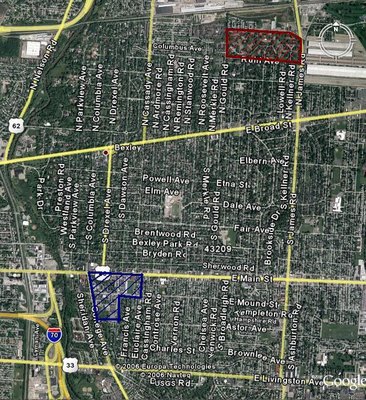
Compare the size of Woodland Meadows (in the upper right, shaded red) to the Campus of Capital University (lower left, shaded blue).


Friday, November 4, 2011

Don’t Forget To Set Clocks Back An Hour Sunday November 06, 2011


Time for change? GMT could be history

Leading scientists from around the world are meeting from Thursday to consider a proposal that could eventually see Greenwich Mean Time relegated to a footnote in history.
For more than 120 years GMT has been the international standard for timekeeping, but it is now under threat from a new definition of time itself based not on the rotation of the Earth, but on atomic clocks.
Daylight Saving Time has been used in the U.S. and in many European countries since World War I. At that time, in an effort to conserve fuel needed to produce electric power, Germany and Austria took time by the forelock, and began saving daylight at 11:00 p.m. on April 30, 1916, by advancing the hands of the clock one hour until the following October. Other countries immediately adopted this 1916 action: Belgium, Denmark, France, Italy, Luxembourg, Netherlands, Norway, Portugal, Sweden, Turkey, and Tasmania. Nova Scotia and Manitoba adopted it as well, with Britain following suit three weeks later, on May 21, 1916. In 1917, Australia and Newfoundland began saving daylight.
The plan was not formally adopted in the U.S. until 1918. ‘An Act to preserve daylight and provide standard time for the United States’ was enacted on March 19, 1918. [See law]It both established standard time zones and set summer DST to begin on March 31, 1918. Daylight Saving Time was observed for seven months in 1918 and 1919. After the War ended, the law proved so unpopular (mostly because people rose earlier and went to bed earlier than people do today) that it was repealed in 1919 with a Congressional override of President Wilson’s veto. Daylight Saving Time became a local option, and was continued in a few states, such as Massachusetts and Rhode Island, and in some cities, such as New York, Philadelphia, and Chicago.
During World War II, President Franklin Roosevelt instituted year-round Daylight Saving Time, called “War Time,” from February 9, 1942 to September 30, 1945. [See law] From 1945 to 1966, there was no federal law regarding Daylight Saving Time, so states and localities were free to choose whether or not to observe Daylight Saving Time and could choose when it began and ended. This understandably caused confusion, especially for the broadcasting industry, as well as for railways, airlines, and bus companies. Because of the different local customs and laws, radio and TV stations and the transportation companies had to publish new schedules every time a state or town began or ended Daylight Saving Time.
On January 4, 1974, President Nixon signed into law the Emergency Daylight Saving Time Energy Conservation Act of 1973. Then, beginning on January 6, 1974, implementing the Daylight Saving Time Energy Act, clocks were set ahead. On October 5, 1974, Congress amended the Act, and Standard Time returned on October 27, 1974. Daylight Saving Time resumed on February 23, 1975 and ended on October 26, 1975.
Inconsistent use in the U.S.
In the early 1960s, observance of Daylight Saving Time was quite inconsistent, with a hodgepodge of time observances, and no agreement about when to change clocks. The Interstate Commerce Commission, the nation’s timekeeper, was immobilized, and the matter remained deadlocked. Many business interests were supportive of standardization, 
In January 2012, the International Telecommunication Union will meet in Geneva to vote on whether to adopt the new measure, despite protests from Britain.
The two-day meeting of about 50 experts at a country house northwest of London, under the aegis of the prestigious Royal Society, on Thursday and Friday will look at some of the issues involved.
Predictably the question has hurt national pride — particularly when British believe their old rivals France are leading the push to change away from GMT to the new time standard.
“We understand that in Britain they have a sense of loss for GMT,” said Elisa Felicitas Arias, director of the time department at the France-based International Bureau of Weights and Measures (BIPM), which pushed for the change.
GMT is based on the passage of the sun over the zero meridian line at the Greenwich Observatory in southeast London, and became the world standard for time at a conference in Washington in the United States in 1884.
France had lobbied for “Paris Mean Time” at the same conference.
In 1972 it was replaced in name by Universal Coordinated Time (UTC) but that essentially remained the same as GMT.
UTC is based on about 400 atomic clocks at laboratories around the world but then corrected with “leap seconds” to align itself with the Earth’s rotational speed, which fluctates.
But the tiny variations between Earth speed and atomic speed have become a problem for GPS, the global positioning systems and mobile phone networks on which the modern world relies.
“These networks need to be synchronised to the millisecond,” Arias said.
The meeting in London will look at the implications of abolishing the leap seconds and moving fully to atomic time.
That would see atomic time slowly diverge from GMT, by about one minute every 60 to 90 years, or by an hour every 600 years, and there would need to be “leap minutes” a couple of times a century to bring the two in line.
The proposal would then formally be voted on in Geneva.
The potential loss of GMT has prompted soul searching in the British press, particularly at a time when the country is itself considering switching to British Summer Time, one hour ahead of GMT, on a permanent basis.
The Sunday Times said GMT had “symbolised Britain’s role as a Victorian superpower” but that “just as that role has inexorably diminished, so GMT itself could in effect disappear.”
Science minister David Willetts has opposed the plan, saying it has become more than just a scientific row.
“This is primarily a finely balanced scientific argument but I do detect undercurrents of nationalism,” he said.
“Britain’s position is that we should stick to real time as experienced by humans, which is based on the Earth’s rotation, not atomic clocks.
“Without leap seconds we will lose contact with the reality of Earth’s rotation. Eventually our midnight would happen at noon.”more
thank you battleskin88

Remember the Black L.A. Teacher, who spoke out against Zionist Jews? Well she got fired for exercising ‘Freedom of Speech’


Remember the Black L.A. Teacher, who spoke out against Zionist Jews? Well she got fired for exercising ‘Freedom of Speech’

AFP interviews Patricia McAllister, the LA schoolteacher fired for exercising her First Amendment rights. The reason McAllister was fired: she dared to associate the word “Jew” with something negative, the last taboo in America. In fact, some would say that even uttering the word “Jew,” rather than “Jewish,” is enough to raise the ire of the power Jews.
If you support her First Amendment right to free speech, sign the petition  to get her reinstated, then, visit her new Web site .
And don’t miss the interview Victor Thorn did with McAllister, below:

Schoolteacher Persecuted for Her Beliefs

By Victor Thorn -
Patricia McAllister is a hero, and she stands as the undisputed reigning champion of free speech in America. Her “Rosa Parks moment” arrived on Oct. 12 when, during an Occupy Los Angeles rally, Reason TV recorded her on camera saying: “I’m here representing myself, but I do work for the Los Angeles Unified School District (LAUSD). I think the Zionist Jews who are running these big banks and our Federal Reserve—which is not run by the federal government—need to be run out of this country.”
On Oct. 18, LAUSD officials fired McAllister. In an exclusive interview with AFP, McAllister explained her dismissal to this writer. “Ira Berman, the director of employee relations for LAUSD, told me, ‘You’re out of a job.’ When I asked for the reason, he responded, ‘I don’t want to talk about why.’”
Superintendent John Deasy later said in a press release, “We recognize the law is very protective of the freedom-of-speech rights of public employees when they are speaking as private citizens during non-working time . . . but we will never stand for behavior that is disrespectful, intolerant or discriminatory.”
This issue became so prominent and explosive that on Oct. 20 the Los Angeles Timesdevoted an editorial to it. They began: “This newspaper ardently supports the right of free speech, even when that speech is controversial, hateful or ignorant. But no right is absolute, and Patricia McAllister crossed a line.”
Their commentary continued with this curious endorsement: “On Tuesday [Oct. 18] Supt. John Deasy fired her. Good for him.”
However, in the following paragraph, the editors seemed to backtrack: “[McAllister] was careful to note that she was not speaking as a  representative of L.A. Unified. And Deasy knows as well as anyone that courts have historically—and correctly—protected teachers’ free-speech rights.”

McAllister on Front Lines of Battle for Free Speech

During an Oct. 21 interview with AFP, Patricia McAllister exercised her right to free speech to the fullest. Here are her comments.
WHERE SHE LEARNED ABOUT ZIONISTS: “I grew up in Chicago when Jewish people still lived with blacks. They don’t do that anymore. Ever since my childhood, I kept asking people: what prompted Adolf Hitler to do what he did? No one had an answer, so I did the research for myself. I discovered why we’re in the position we’re in today—because of Zionist Jews and the Federal Reserve.”
ON THE FEDERAL RESERVE: “Nine Jewish owners, including the Rothschilds, Lazard Brothers, Kuhn Loeb, the Warburgs, Lehman and  Goldman Sachs, among others, print money that is backed by nothing. The American people are then taxed to pay interest on money that Zionist Jews put in their pockets. It’s called racketeering, and it’s illegal. The IRS and Federal Reserve are both illegal, and the taxes they collect from us to pay interest is highway robbery.”
FOX NEWS 11 QUOTE: On Oct. 18 during a live telecast, McAllister said: “Jews have been run out of 109 countries throughout history, and we need to run them out of this one.” She told AFP: “The Jews have a long history of resentment because people hate them. But they’re not hated for being Jews, but due to their behavior. By going in and taking over everything, they’ve actually destroyed civilizations. When it comes to  socialization, the Jews are sociopaths. They won’t assimilate. They’ve been causing problems for years, and we need to expel them from the U.S. They also need to release control of the Federal Reserve, and they can’t ever be allowed to come here again.
“We need to do what Hitler did and run them out of our country. . . . I’m not talking about everyday Jews, but instead Zionists at the Federal Reserve. They’re getting more and more ruthless, and we have to do something.
“I think Hitler saw something that we don’t see. I also don’t believe that 6 million Jews were killed. That’s just something to pull our heartstrings.”more

Thursday, November 3, 2011

Tattooed? Overweight? The PLA Still Wants You


Tattooed? Overweight? The PLA Still Wants You

The People’s Liberation Army has recently relaxed the rules for enlistment in a drive to improve the Chinese military’s recruiting numbers. No longer banned: people with small tattoos, those still carrying around a little baby fat and those who should probably switch to whole milk from skim.
China’s legislature, the National People’s Congress, approved an amendment to the country’s Military Service Law on Monday with the goal of recruiting more well-educated soldiers.

Among the adjustments, according to a representative of the Beijing Military Recruitment Office, are a relaxation of rules governing weight and tattoos. New recruits will now be allowed to be 25% heavier or 15% skinnier than what the military considers an ideal weight, and people with tattoos on the neck or face — grounds for automatic rejection in the past — will now be considered, so long as the ink in question doesn’t exceed two centimeters in diameter.
The amendment also offers enticements specifically targeted at college students who decide to join the military before graduation, including post-service yearly tuition contributions as high as 6,000 yuan ($944).
Recruits from top universities in Beijing, meanwhile, will enjoy the ability to choose their own major (a rarity among Chinese college students), a one-time scholarship payment of 30,000 yuan and, if needed, a leg-up in securing a highly coveted Beijing residence permit.
It might be hard to imagine pudgy, mildly tattooed college students filling the ranks of the PLA, which still trumpets a history of having twice sent bands of scrappy guerrilla fighters out to wage successful campaigns against better-equipped enemies (the Nationalist Party during China’s civil war and the U.S.-led United Nations forces during the Korean War). But as RAND Corp. political scientist Roger Cliff noted in testimony before the U.S. China Economic and Security Review Commission in January (pdf), the PLA’s main focus in recent years has been on preparing for warfare “under high-technology conditions,” including on the Internet.
That effort is what’s behind the changes in recruitment policy, according to the Beijing Recruitment Office representative. “The army’s development requires more young people with higher education levels,” he said, adding that “the ability to grasp new technology” was an important criterion.
So why relax the rules on weight and body art?
According to the Beijing Recruitment Office representative, one reason is the one-child policy, which has significantly reduced China’s population of service-eligible youth.
Maoist fighter of the PLA
A state-run Xinhua news agency interview with a Beijing Military Recruitment Office vice-director Zhou Yongshan in September suggests another reason: fear among top potential recruits of being unable to find a job after being discharged.
“We understand that one big reason some college students are not positive enough about joining the army is that some aspects of post-discharge arrangement policy are generally not strong in terms of implementation,” Mr. Zhou Yongshan said (in Chinese). To solve the problem, he said, required new policies that would allow college students “to see the spaciousness of the entrance gate and, at the same time, see how the exit road has been widened.”more from wsj