Showing posts with label Clinton. Show all posts

Saturday, May 18, 2013

Just who is Thomas 'Mack' McLarty, and why should you really care!


Prior to his tenure in the White House, Mr. McLarty served as Chairman of Arkla, a Fortune 500 natural gas company.  During his tenure Arkla grew into the nation’s largest natural gas distributor, with customers in 11 states and significant exploration and pipeline operations.  The company was recognized by Forbes and Wall Street Transcript for management excellence, and by other national organizations for environmental initiatives and minority enterprise development.  Mr. McLarty began his business career as a third generation participant in McLarty Companies, where he helped build the business his grandfather founded into one of the nation’s largest transportation companies.

Mr. McLarty serves on the boards of a number of corporate and non-profit institutions including Union Pacific, the Acxiom Corporation, the Bush Clinton Katrina Fund, the Council of the Americas, the Inter-American Dialogue, Ford’s Theatre, and the Center for the Study of the Presidency.  In addition, he is senior counselor to the Center for Strategic and International Studies, a Senior International Fellow at the U.S. Chamber of Commerce and is a member of the Council on Foreign Relations.  more


John Brummett: Mack McLarty and amnesty

Published Thursday, September 06, 2001

In case you wondered what became of Thomas F. "Mack" McLarty, the former Arkla chairman and the first White House chief of staff and later Latin American liaison for his boyhood friend, Bill Clinton, I need only refer you to international political news.

The article revealed that the man who now is Mexico's foreign minister, Andres Rozental, buttonholed McLarty at a black-tie affair at Tavern on the Green in New York City in the winter of 2000. The Mexican diplomat persuaded McLarty, now an international consultant in partnership with Henry Kissinger, to become the American chairman of a bilateral commission of political, educational and business leaders to study American-Mexican migration under the aegis of the Carnegie Foundation.

The commission's report, delivered in February by McLarty to Bush's chief of staff, Andrew Card, recommended a policy commonly referred to, and probably over-stated, as amnesty -- meaning a process for legalizing at least some of the millions of undocumented Mexican immigrants gainfully employed in the United States and free of criminal complications except for the basic illegality of their presence. The report became a factor in Bush's decision to float the idea of amnesty.

On Tuesday, as I tracked down McLarty to talk with him about his intimate involvement in the timely issue, I learned that he was detained at a meeting of the U.S.-Mexico Binational Council, a separate group and an offshoot of the Center for Strategic and International Studies, and that the council was preparing to release its report that afternoon to coincide with Fox's arrival in Washington on Wednesday.

This second commission could not reach consensus on amnesty. Some, like McLarty, found it humane and practical. Others found it ill-advised in that it might open flood gates and reward illegals over others who have followed proper channels.

McLarty got back with me that evening. He said narcotics trafficking was probably the most destructive issue between the United States and Mexico, but that immigration was "the most complicated and the most emotional."
Famously cautious, even euphemistic, in his phrasing, McLarty said he didn't like or use the word "amnesty."
He preferred to talk about "a path to citizenship for many of the undocumented workers, mostly Mexicans, that matches our policies with the realities." By that he meant that the American economy now relies on migrant labor and that responsible illegals with jobs and families deserve services for the taxes they pay. He said that when Japan curbed immigration, its thriving economy began to suffer.

He said this "path to citizenship" must be "incremental," and that Fox, whom he admires, got ahead of himself talking about free labor movement across the border. That's a couple of decades away, at least, he said.

Fracking the life out of Arkansas and beyond

The last four months of 2010, nearly 500 earthquakes rattled Guy, Arkansas. [1]  The entire state experienced 38 quakes in 2009. [2] The spike in quake frequency precedes and coincides with the 100,000 dead fish on a 20-mile stretch of the Arkansas River that included Roseville Township on December 30. The next night, 5,000 red-winged blackbirds and starlings dropped dead out of the sky in Beebe. [3]  Hydraulic fracturing is the most likely culprit for all three events, as it causes earthquakes with a resultant release of toxins into the environment. [4]

ARKANSAS EARTHQUAKE AND DRILLING HISTORY
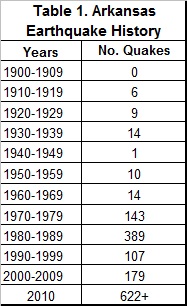
When comparing Arkansas’ earthquake history with its drilling history, a causative correlation becomes obvious.

The entire 19th century saw 15 recorded earthquakes and none in the first decade of the new century.  A total of 694 quakes rocked Arkansas in the 20th century.  That number was surpassed in 2009-2010, with the bulk (483) occurring the last three months of 2010. Table 1 was prepared using complete quake data thru 2009 [15], complete data from August thru December, 2010 [1], and just North Central Arkansas quake data from January thru July, 2010. [16]
Arkla, Inc., through its many morphs, mergers and acquisitions,  is and has been a key gas driller in Arkansas.  Between 1975 and the early 1980s, the company found more gas than it produced. By 1982, Arkla was able to sell Central Louisiana Electric Company more than 100 million cubic feet of gas daily. By the early 1990s, it operated the sixth-largest pipeline system in the United States and was among the ten largest operators of natural gas reserves. [17] Its production timeline coincides with the massive jump in earthquakes in the 1970s and 1980s. Today, 37 companies drill for gas and oil in Arkansas. [18]


RLJ Companies » RLJ McLarty Landers Management Team
THOMAS “MACK” McLARTY
Clinton’s kindergarten palThomas “Mack” McLartyserved as White House chief of staff before being appointed the president’s special envoy for the Americas, playing a key part in advancing NAFTA. McLarty later formed a consulting firm, which merged with Kissinger Associates in 1999 only to break from it in 2008. More recently he has been chosen by the outgoing Bush administration as an adviser to the team aiding Barack Obama’s transition to the Oval Office.


Thomas F. McLarty, III         

RLJ Companies » RLJ McLarty Landers Management Team
Vice Chairman
Thomas F. McLarty has a distinguished record of business leadership and public service, including various roles advising three U.S. Presidents: Bill Clinton, George H. W. Bush and Jimmy Carter. Mr. McLarty worked with President Carter as a member of the Democratic National Committee, was appointed to two commissions by President Bush and served President Clinton in several key positions: Chief of Staff, Counselor to the President and Special Envoy for the Americas, with over five years of service in the President’s Cabinet and on the National Economic Council. Upon leaving the White House in July 1998, Mr. McLarty became President of Kissinger McLarty Associates, an international advisory firm formed in partnership with former Secretary of State Henry Kissinger.

He is also Chairman of McLarty Companies, a fourth-generation family transportation business, including a major automotive retail endeavor — RLJ-McLarty-Landers — a partnership with Robert Johnson and Steve Landers. Additionally, Mr. McLarty serves as Senior Adviser to The Carlyle Group, a private equity firm, as Senior Adviser to the law firm Covington & Burling and as Chairman of Randall & Dewey, a leading global energy industry advisory firm.

As White House Chief of Staff, Mr. McLarty helped enact the historic 1993 deficit reduction package, the North American Free Trade Agreement, the Family and Medical Leave law and the landmark welfare reform legislation that enabled more than 6.8 million people to move from welfare to work. He also organized the successful 1994 Summit of the Americas in Miami, which ultimately led to his appointment as Special Envoy for the Americas in 1997.

As Counselor to the President, Mr. McLarty advised on a broad range of international and domestic issues. He traveled to the Persian Gulf on the President’s behalf to build financial support for the Bosnian peace process, led the U.S. delegation to the inauguration of South Korean President Kim Dae-jung and signed the peace accords that brought peace to Guatemala for the first time in three decades. Mr. McLarty planned U.S. participation in the 1998 “Summit of the Americas” in Santiago, and participated in several G-7 and APEC Summits. He also served as White House Coordinator for the Centennial Games in Atlanta, a role for which he was honored with the Olympic Torch from the Atlanta Organizing Committee and the Olympic Shield from the U.S. Olympic Committee — that organization’s highest award.



Waste Technologies Industries (WTI)East Liverpool, Ohio toxic waste incineratorVice President Gore's first broken campaign promise


Hillary Clinton helped incorporate WTI while at the Rose Law Firm and served on the board of LaFarge Cement, which operates a cement kiln in Alpena, Michigan on Lake Huron that switched from natural gas to burning hazardous wastes (used motor oil, solvents) in the mid-1980s.
Clinton's Region 3 [mid-atlantic] EPA Administrator - Peter Kostmayer, a democratic Congressman from Pennsylvania who lost his seat in 1992 (he'd introduced legislation to ban new incinerators) - was fired for opposing the Environmental Impact Statement for the proposed $1.5 billion 118 mile "Corridor H" superhighway through the mountains of West Virginia and the water discharge permit for the Parsons & Whittemore paper pulp mill in Apple Grove, WV, on the Ohio River (the mill would be the largest in the country, and would dump dioxin into the river). West Virginia Governor Gaston Caperton and Senators Byrd and Rockefeller complained to Clinton (the paper mill contributed to West Virginia politicians and to the Democratic National Committee), who complained to EPA Administrator Carol Browner, who fired Kostmayer.  Perhaps Bill Clinton could have urged neighbors of the WTI incinerator not to inhale.

Sunday, October 23, 2011

Libya is happy to be rid of Gadhafi, hate to tell U.S. Secretary Clinton but Islamic Sharia law would be the “basic source” of legislation now.

Hillary Clinton, who is on a two-day visit to Pakistan, was in Tripoli earlier this week to pledge £7 million in aid to Libya.

— Libya’s transitional leader declared his country’s liberation on Sunday, three days after the hated dictatorMoammar Gadhafi was captured and killed.
Reacting to the news of Gaddafi’s death, the United States Secretary of State said: “The death of Colonel Gaddafi has brought to a close a very unfortunate chapter in Libya’s history. But it also marks the start of a new era for the Libyan people, and it is our hope that what I saw in Tripoli on Tuesday first hand, the eagerness of Libyans to building a new democracy, can begin in earnest.”

He called on Libyans to show “patience, honesty and tolerance” and eschew hatred as they embark on rebuilding the country at the end of an 8-month civil war.

The transitional government leader Mustafa Abdul-Jalil set out a vision for the post-Gadhafi future with an Islamist tint, saying thatIslamic Sharia law would be the “basic source” of legislation in the country and that existing laws that contradict the teachings of Islam would be nullified. In a gesture that showed his own piety, he urged Libyans not to express their joy by firing in the air, but rather to chant “Allahu Akbar,” or God is Great. He then stepped aside and knelt to offer a brief prayer of thanks.

Islam’s legal lexicon

How to speak sharia

LITERALLY the “path” or “path to water”, sharia is a catch-all term for Islamic codes covering everything from social mores to crime. Based on the Koran and the sayings attributed to Muhammad, as well as the work of ulema (Muslim scholars), it is clear and strict in some matters (such as family law) and fluid and evolutionary in others (such as commerce). It comprises five main schools of interpretation (four Sunni and one Shia). In Muslim lands sharia courts are overseen by a kadi (judge) who will have studied both fiqh(legal interpretation) and how to apply qiyas (analogy).
Fiqh classifies behaviour into one of five categories: fard (mandatory), mustahabb(advisable), mubah (neutral), makruh (inadvisable), and haraam (prohibited). Huddudrefers to the corporal and capital punishments that are laid down in traditional Islamic law for certain offences, including death by stoning for adultery. However, fatwa (ruling or opinion), contrary to popular opinion in the West, refers to theological, not legal, pronouncements in which one or more scholars opine on some pressing issue (the subjects of recent fatwas have ranged from questions of personal hygiene to the ethics of suicide-bombing).
“This revolution was looked after by God to achieve victory,” he told the crowd at the declaration ceremony in the eastern city of Benghazi, the birthplace of the uprising against Gadhafi began. He thanked those who fell in the fight against Gadhafi’s forces. “This revolution began peacefully to demand the minimum of legitimate rights, but it was met by excessive violence.”
Abdul-Jalil said new banks would be set up to follow the Islamic banking system, which bans charging interest. For the time being, he said interest would be canceled from any personal loans already taken out less than 10,000 Libyan dinars (about $7,500).
He also announced that all military personnel and civilians who have taken part in the fight against Gadhafi would be promoted to the rank above their existing one. He said a package of perks would later be announced for all fighters.

Islam, Sharia law and democracy


“Thank You, thank you to the fighters who achieved victory, both civilians and military,” he said. He also paid tribute to the Gulf Cooperation Council, a six-nation alliance led by Saudi Arabia, The Arab League and the European Union. NATO, more
Earlier, the US Secretary of State’s first reaction to the news of Gaddafi’s capture was caught on camera ahead of a television interview.source

Thursday, July 21, 2011

‘Look UN, The Piggy Bank Is Broke!’ Where are you going to go when there is no more?


‘Look UN, The Piggy Bank Is Broke!’ Where are you going to go when there is no more?


In The USA  And European Countries Your Asking  To Give Money In Case You Haven’t Noticed We Have Many Of The Same Issues:  War, Drought, Hunger, and Financial  Issues Of Our Own!  shera~


NAIROBI, Kenya – Parts of southern Somalia are suffering from famine, a U.N. official said Wednesday, and tens of thousands of Somalis have already died in the worst hunger emergency in a generation.
The Horn of Africa is suffering a devastating drought compounded by war, neglect and spiraling prices. Some areas in the region have not had such a low rainfall in 60 years, aid group Oxfam said.

“Desperate” Somalia famine puts 11M at risk


The U.N. needs $300 million in the next two months, said Mark Bowden, the U.N.’s top official in charge of humanitarian aid in Somalia. The last time conditions were this bad was in 1992, when hundreds of thousands of Somalis starved to death. That famine prompted intervention by an international peacekeeping force, but it eventually pulled out after two American Black Hawk helicopters were shot down in 1993.


Hunger in the United States
35.5 million people (including 12.6 million children) experience hunger or the risk of hunger.
This is roughly 10.9 percent of the 301 million people in the U.S. (July 2007 estimate)
4.0 percent of U.S. households (11.1 million people, including 0.43 million children) experience hunger. Some families skip meals, eat too little, or go a whole day without food.
1 out of every 8 households in the United States has reduced the quality of its diet to utilize money elsewhere (rent, clothing, day care).
6.9 percent of U.S. households (24.4 million people, including 12.2 million children) are at risk of hunger.
In 2007, an average of 26.5 million people participated in the Food Stamp Program each month (8.8 percent of the U.S. population).
In 2006, requests for emergency food assistance increased 7 percent. Of those requesting emergency food assistance, 48 percent were members of families with children, and 37 percent of adults requesting assistance were employed.
America’s Second Harvest, the nation’s largest network of food banks, reported that an estimated 24 to 27 million people turned to its agencies in 2006.

Somalia is facing its worst food security crisis in the last 20 years,” Bowden said. “This desperate situation requires urgent action to save lives.”
Famine is officially defined as when two adults or four children per 10,000 people die of hunger each day and a third of children are acutely malnourished. In some areas of Somalia, six people are dying a day and more than half of children are acutely malnourished, Bowden said. Prices of staple foods have increased 270 percent over the last year.
On Wednesday, U.S. Secretary of State Hillary Rodham Clinton said the U.S. will give another $28 million, on top of the $431 million in assistance it has given to the Horn of Africa this year, which Clinton said was simply “not enough.”
Britain has pledged $145 million in the past two weeks — about 15 percent of what is needed — and the European Union pledged around $8 million, with more expected in coming days. Spain has promised nearly $10 million and Germany around $8.5 million but Oxfam said France has so far not pledged any more money and Denmark and Italy have said no significant new sums are available.
“There is no time to waste if we are to avoid massive loss of life,” Equiza said in a statement. “We must not stand by and watch this tragedy unfold before our eyes. The world has been slow to recognize the severity of this crisis, but there is no longer any excuse for inaction.”
Some donors, like the U.S., have expressed fears that aid might be diverted byIslamist groups.


Wednesday, June 29, 2011

Someone please tell me again how and why this is a United $tates Problem?


How U.S. Budget Cuts Prolong Global Slavery


Three days before the U.S. congressional elections last fall, Hillary Clinton stood halfway around the world from Washington, pledging to young victims of human trafficking at Cambodia’s Siem Reap Center that they would continue to enjoy the support of the U.S. State Department, which then provided some $336,000 to the shelter. The acclaimed center, situated near the magnificent temples of Angkor Wat, was an oasis of peace for some 50 survivors who, before they were rescued or escaped, had endured slavery in brothels, where they were forced to have sex with as many as 30 men a day. At the shelter, they received counseling, studied hairdressing, learned to sew, and otherwise worked to rebuild their lives and reclaim their humanity. In the evenings, they did aerobics together.
On Monday afternoon, some eight months after that visit, as she unveiled the State Department’s 11th annual Trafficking in Persons (TIP) Report to a packed room in the department’s ornate Benjamin Franklin Room, Clinton only hinted that the result of the congressional elections had left in doubt the long-term value of her pledge to the survivors. “Even in these tight economic times, we need to find ways to do better,” Clinton told the overflowing crowd.(Watch “Nepal: Escaped from the Sex Trade, Unable to Go Home.”)
Clinton’s confidence belied the fact that in April, Congress slashed the grant-making capacity of the State Department’s Office to Monitor and Combat Trafficking in Persons. When the Republicans won the House last November, the office’s $21.2 million annual budget to fight the war on slavery was already microscopic. At the time, it was barely equal to the U.S. government’s daily budget to fight the war on drugs. For fiscal year 2012, Congress sliced away nearly a quarter of those antislavery funds, as part of its broader $8 billion State Department budget cuts.
For Mark Lagon, a former Republican staffer on the Senate Foreign Relations Committee who headed the TIP office during the Bush Administration’s second term, the budget cuts are “a sign that all programs are evenly hit, even those with broad nonpartisan support.” But Lagon was troubled that shoestring yet lifesaving overseas antislavery programs would feel those cuts most dearly. “We need to spend 10 times as much on fighting human trafficking and ending slavery,” said Lagon, “and it would still be a bargain even at that price.”
In this year’s trafficking report, the constraints on the TIP office are not limited to the budget. Annually, the report ranks countries based on how well they fought slavery in the previous year. Countries demonstrating the most effective antitrafficking efforts are placed in Tier 1; recalcitrant nations are placed in Tier 3, where they could face nontrade sanctions, including prohibitions on development assistance. While the 2011 report ranks most of the 184 countries in the middle, the State Department ranked 42 nations just above those threatened with sanctions, on the watch list of Tier 2. Antislavery activists claim that ranking a country in the watch list for some consecutive years amounts to a cop-out. In congressional testimony last year, Holly Burkhalter, vice president for government relations at the International Justice Mission, decried the misuse of the list as a “parking lot for U.S. allies that actually belonged in Tier 3.”(Healthland: “State Dept. Report Targets Human Trafficking in the U.S.”)
Three years ago, when Congress reauthorized the 2000 Trafficking Victims Protection Act, the law that created the TIP office, it moved to clear out the “parking lot.” The new law mandated that any country that had been on the watch list for two consecutive years would be downgraded to Tier 3, unless that country presented a written plan and a demonstrated capacity to improve its slavery record. This year, all but five of the 19 “parking lot” occupants avoided the automatic downgrade. Of those five that were dropped under the law, Libya and Venezuela join Cuba, North Korea, Sudan, Zimbabwe and other Tier 3 countries already facing U.S. sanctions. more:

Tuesday, October 5, 2010

Holder’s racist policy only tip of the iceberg

HOLDER’S DISTURBING POLITICAL HISTORY

In 1999, then a deputy attorney general Eric Holder helped arrange Bill Clinton pardons for 16 unrepentant members of FALN who had been convicted of “a variety of charges that included conspiracy, sedition, violation of the Hobbes Act (extortion by force, violence or fear), armed robbery and illegal possession of weapons and explosives — including large quantities of C-4 plastic explosive, dynamite and huge caches of ammunition.”

Eric Holder pushed for controversial clemency January 09, 2009|
— Attorney general nominee Eric H. Holder Jr. repeatedly pushed some of his subordinates at the Clinton Justice Department to drop their opposition to a controversial 1999 grant of clemency to 16 members of two violent Puerto Rican nationalist organizations, according to interviews and documents.  Details of the role played by Holder, who was deputy attorney general at the time, had not been publicly known until now. The new details are of particular interest because Republican senators have vowed to revisit Holder’s role during his confirmation hearings next week.

More and more Americans are discovering that the Obama Administration’s definition of transparency is more Clintonian and semantic than it is honest and encouraging.
In addition, the Obama White House is successfully preventing — with the help of their minions populating the mainstream news media –the discovery that Attorney General Eric Holder has been less than forthcoming about his activities prior to being appointed U.S. Attorney General.

General Eric Holder’s 2009 Freedom of Information Act (FOIA) guidelines.

Holder’s guidelines were supposed to aid President Barack Obama’s “new era of open government” by establishing a “criteria governing the presumption of disclosure” and creating “effective systems for responding to requests.”