Showing posts with label 'Why Israel' protests. Show all posts

Thursday, March 22, 2012

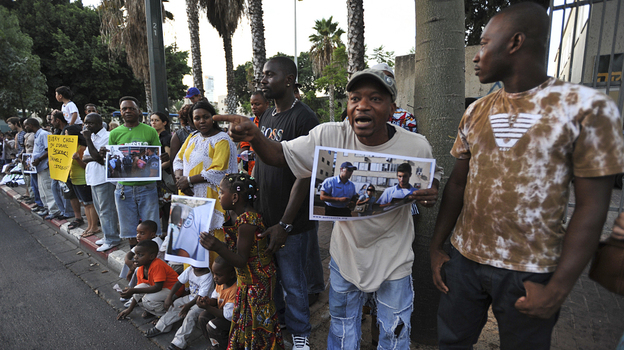
As (40,000) Illegal African Immigrants Increase, Israel Plans To Act


Egypt did not meet its obligations, and the UN concluded that Sweden had violated international conventions against torture since it was aware of Egypt's troublesome record on such matters. Israel's expulsion of 50 nationals of African countries to Egypt on Saturday may also be viewed as a violation of that same convention, in light of testimonies received in the past about the conditions of incarceration and the torture suffered by African asylum-seekers who were expelled to Egypt from Israel.
Attorney General Menachem Mazuz argues that Israel did not "expel" the refugees, but rather Israel "prevented their entry" into the country and is therefore not violating international accords.
According to international law, any person who crosses the border of a country and claims asylum, even if this person is not recognized as a refugee, is entitled to a hearing. 
International refugee law
 
International refugee law is a set of rules and procedures that aims to protect, first, persons seeking asylum from persecution, and second those recognized as refugees under the relevant instruments. Its legal framework provides a distinct set of guarantees for these specific groups of persons, although, inevitably, this legal protection overlaps to a certain extent with international human rights law as well as the legal regime applicable to armed conflicts under international humanitarian law.
The main sources of refugee law are treaty law, notably the 1951 Convention relating to the status of refugees (1951 Refugee Convention) and its 1967 Protocol, and customary international law. Customary international law applies to all states irrespective of whether they are a party to relevant treaties or not. Regional instruments represent a further set of protections, particularly the 1969 Organization of African Unity Convention (for Africa) and, although it is not formally legally binding, the 1984 Cartagena Declaration (for Latin America).
The Definition of a Refugee
International legal protection of refugees centres on a person meeting the criteria for refugee status as laid down in the 1951 Refugee Convention. Under Article 1(A)2, the term “refugee” shall apply to any person who:
“...owing to well-founded fear of being persecuted for reasons of race, religion, nationality, membership of a particular social group or political opinion, is outside the country of his nationality and is unable or, owing to such fear, is unwilling to avail himself of the protection of that country; or who, not having a nationality and being outside the country of his former habitual residence as a result of such events, is unable or, owing to such fear, is unwilling to return to it.”
Thus, according to this provision, refugees are defined by three basic characteristics:
  • they are outside their country of origin or outside the country of their former habitual residence;
  • they are unable or unwilling to avail themselves of the protection of that country owing to a well-founded fear of being persecuted; and
  • the persecution feared is based on at least one of five grounds: race, religion, nationality, membership of a particular social group, or political opinion.
It is important to stress that the term “asylum seekers” refers to persons, who have applied for asylum, but whose refugee status has not yet been determined.    


The place is Tel Aviv, but it doesn't look at all like Israel: Dozens of African men are sitting on broken stools and plastic at a makeshift restaurant.
Sudanese fare is on the menu. The men scoop up the stews and salads that remind them of home.
Abdullah Mohammad Mustafa started this restaurant with a couple of other African men who arrived in Israel five years ago from Sudan's troubled Darfur region. They are among some 40,000 Africans who have come to Israel illegally, and many have congregated in neighborhoods in Tel Aviv.
Mustafa is among the many Africans and Asians who have been arriving in Israel in recent years, and most have been sneaking across the country's porous southern border with Egypt.  


Israel is now taking a series of steps to stop the influx and reverse the flow. This summer, Israel will begin deporting those who agree to leave voluntarily. Other parts of the plan are still under construction — like a 150-mile fence being built along the border with Egypt. And there will also be a massive detention center.
"Like many other countries in the world, Israel faces a serious problem with illegal immigration," says Josh Hantman, a spokesman for Israel's Defense Ministry. "Israel always has to find the most humane way of dealing with this tricky issue."
He says the detention center, which will be completed later this year, will have spacious rooms, computers and a sports center. Detainees will have access to lawyers and health care.
By the end of this year, Israeli officials say, the facility will be able to hold several thousand people. By the time it is fully built, it will have a total capacity of 11,000 people — making it one of the largest detention facilities in the world.
"We see from other countries that the effect of detention centers on asylum seekers that went through trauma in their home countries, or on their way to Israel, will be very harmful for their health, both mental and physically," says Shachar Shoham, the director of the Migrants Department at Physicians for Human Rights.
Shoham says Israel already has a policy of detaining some of the people who enter the country without permission. Up until now, they've been sent to Ketziot, a sprawling prison in southern Israel.more from Npr


Wednesday, January 18, 2012

Internet Sites Blacked Out In Protest of SOPA For January 18, 2012


SOPA protests shut down Web sites


The idea is to cut off the channels that deliver American customers, and their money, to potential pirates. But tech companies see the laws as a dangerous overreach, objecting because, they say, the laws would add burdensome costs and new rules that would destroy the freewheeling soul of the Internet.
“The voice of the Internet community has been heard,” Rep. Darrell Issa (R-Calif.), who sided with the tech companies, said in a statement. Issa said he had already been told of a victory: GOP leaders told him that the House would not vote on a version of the bill that those companies oppose. “Much more education for Members of Congress about the workings of the Internet is essential.”
The biggest impact of Wednesday’s blackout may be in the shutdown of the English-language version of Wikipedia, which gets 2.7 billion U.S. visitors per month.
“It is the opinion of the English Wikipedia community that both of these bills, if passed, would be devastating to the free and open web,” said a statement  signed by three of the free encyclopedia’s administrators, with the handles “NuclearWarfare,” “Risker” and “Billinghurst.” They said the decision to shut down the English-language portion of the site, starting at midnight Eastern time, had been made after a virtual discussion that involved 1,800 users.


This is a great thing that so many are protesting the US Government by blacking out their web sites.  Let's hope this works and in all honesty I think it should have been a World Wide protest not an 'English portion of a site taken down', due to the fact that so many of the WWW sites rely on American site hits, information and purchases.


The picture below was taken from the story:

These Websites Are Going Dark to Protest SOPA Wednesday at mashable.com

Sites Going Dark on Jan. 18 to Protest SOPA


  • Imgur
  • Tor Project
  • Miro
  • iSchool at Syracuse University
  • Oreilly.com
  • Wikipedia
  • Reddit
  • Mozilla
  • WordPress.org
  • icanhazCheezburger Network
  • MoveOn.org
  • Good Old Games
  • TwitPic
  • Minecraft
  • Free Press
  • Mojang
  • XDA Developers
  • Destructoid


This doesn't make sense when I saw this list of 'CONFIRMED  PARTICIPANTS'/SITES, That Would Black Out'  I'm glad it's still up so that I can write this but you know what I mean.


GOOGLE being the top site.  Awesome, but that is not true because if it was I wouldn't be writing this blog on www.blogger.com, or able to check my email, or do 'GOOGLE searches' which I can.


Thursday, November 17, 2011

Our Weapon Is Truth


Our Weapon Is Truth


A Conservative Estimate of Total Direct U.S. Aid to Israel: Almost $114 Billion

By Shirl McArthur

TABLE 1: Direct U.S. Aid to Israel (millions of dollars)

Year
Total
Military
Grant
Economic
Grant
Immigrant
ASHA
All Other
1949-1996
68,030.9
29,014.9
23,122.4
868.9
121.4
14,903.3
1997
3,132.1
1,800.0
1,200.0
80.0
2.1
50.0
1998
3,080.0
1,800.0
1,200.0
80.0
?
?
1999
3,010.0
1,860.0
1,080.0
70.0
?
?
2000
4,131.85
3,120.0
949.1
60.0
2.75
?
2001
2,876.05
1,975.6
838.2
60.0
2.25
?
2002
2,850.65
2,040.0
720.0
60.0
2.65
28.0
2003
3,745.15
3,086.4
596.1
59.6
3.05
?
2004
2,687.25
2,147.3
477.2
49.7
3.15
9.9
2005
2,612.15
2,202.2
357.0
50.0
2.95
?
2006
2,534.53
2,257.0
237.0
40.0
?
.53
2007
2,500.24
2,340.0
120.0
40.0
?
.24
2008
2,423.8
2,380.6
0.0
39.7
3.0
.5
Total
103,614.67
56,024.0
30,897.0
1,557.9
143.3
14,992.47
Notes: FY 2000 military grants include $1.2 billion for the Wye agreement and $1.92 billion in annual military aid. FY 2003 military aid included $1 billion from the supplemental appropriations bill. The economic grant was earmarked for $960 million for FY 2000 but was reduced to meet the 0.38% rescission. Final amounts for FY 2003 are reduced by 0.65% mandated rescission, the amounts for FY 2004 are reduced by 0.59%, and the amounts for FY 2008 are reduced by .81%.

U.S. Aid To Israel

by Mitchell Bard

(Updated January 13, 2010)


“It is my responsibility to see that our policy in Israel fits in with our policy throughout the world; second, it is my desire to help build in Palestine a strong, prosperous, free and independent democratic state. It must be large enough, free enough, and strong enough to make its people self-supporting and secure,” President Truman said in a speech October 28, 1948.
Truman’s commitment was quickly tested after Israel’s victory in its War of Independence when she applied to the U.S. for economic aid to help absorb immigrants. President Truman responded by approving a $135 million Export-Import Bank loan and the sale of surplus commodities to Israel. In those early years of Israel’s statehood (also today), U.S. aid was seen as a means of promoting peace.
In 1951, Congress voted to help Israel cope with the economic burdens imposed by the influx of Jewish refugees from the displaced persons camps in Europe and from the ghettos of the Arab countries. Arabs then complained the U.S. was neglecting them, though they had no interest in or use for American aid then. In 1951, Syria rejected offers of U.S. aid. Oil-rich Iraq and Saudi Arabia did not need U.S. economic assistance, and Jordan was, until the late 1950s, the ward of Great Britain. After 1957, when the United States assumed responsibility for supporting Jordan and resumed economic aid to Egypt, assistance to the Arab states soared. Also, the United States was by far the biggest contributor of aid to the Palestinians through UNRWA, a status that continues to the present.
U.S. economic grants to Israel ended in 1959. U.S. aid to Israel from then until 1985 consisted largely of loans, which Israel repaid, and surplus commodities, which Israel bought. Israel began buying arms from the United States in 1962, but did not receive any grant military assistance until after the 1973 Yom Kippur War. As a result, Israel had to go deeply into debt to finance its economic development and arms procurement. The decision to convert military aid to grants that year was based on the prevailing view in Congress that without a strong Israel, war in the Middle East was more likely, and that the U.S. would face higher direct expenditures in such an eventuality.
Israel has received more direct aid from the United States since World War II than any other country, but the amounts for the first half of this period were relatively small. Between 1949 and 1973, the U.S. provided Israel with an average of about $122 million a year, a total of $3.1 billion (and actually more than $1 billion of that was loans for military equipment in 1971-73) . Prior to 1971, Israel received a total of only $277 million in military aid, all in the form of loans as credit sales. The bulk of the economic aid was also lent to Israel.

Judaic Treasures of the
Library of Congress:
The Talmud