Sunday, March 30, 2014

Hebrew Immigrant Aid Society: US should bring 75,000 Syrians to US over next 5 years!

We want at least 75,000 Syrians here in the US within 5 years now that security screening has been relaxed. http://www.c-spanarchives.org/program/USRefu

We just mentioned earlier today that the public relations push was on to bring a large number of Syrians to the US so that federal contractors like the Hebrew Immigrant Aid Society (HIAS) could be paid to locate them in your city or town.  Never mind that there are few jobs for them, and even if the Syrian civil war ends, they will never go back to Syria.
Now here comes Melanie Nezer, VP for policy and advocacy at HIAS writing at theNew York Daily News—America open your arms!
The United States should commit to resettling at least half of the refugees identified by the UN Refugee Agency as needing resettlement – or at least 15,000 each year over the next five years. This should be in addition to the 70,000 refugees the U.S. has committed to resettle who are survivors of conflicts elsewhere in the world. Other countries have already pledged*** to resettle thousands of Syrians and should be urged to take more.
We watched this very same campaign with Iraq and now we are approaching (or have already topped) 100,000 Iraqis resettled in the US.

Thursday, March 20, 2014

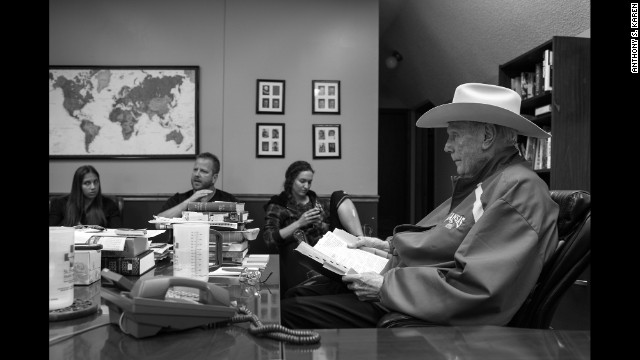
DING DONG, FRED PHELPS IS DEAD!!! Westboro Baptist Church Leader DEAD


(CNN) -- Fred Phelps -- the founding pastor of a Kansas church known for its virulently anti-gay protests at public events, including military funerals -- has died, the church said Thursday.
The 84-year-old died of natural causes at 11:15 p.m. Wednesday, according to church spokesman Steve Drain.
Phelps founded Westboro Baptist Church of Topeka, Kansas, in 1955 and molded it in his fire-and-brimstone image. Many members of the small congregation are related to Phelps through blood or marriage.
In a statement Thursday, the church chided the "world-wide media" for "gleefully anticipating the death."
Photos: Pastor Fred PhelpsPhotos: Pastor Fred Phelps
2003: Phelps on Matthew Shepard statue

According to Westboro, the church has picketed more than 53,000 events, ranging from Lady Gaga concerts to funerals for slain U.S. soldiers. Typically, a dozen or so church members -- including small children -- will brandish signs that say "God Hates Fags" and "Thank God for Dead Soldiers."
"God forbid, if every little soul at the Westboro Baptist Church were to die at this instant, or to turn from serving the true and living God, it would not change one thing about the judgments of God that await this deeply corrupted nation and world."


Phelps was often called "the most hated man in America," a label he seemed to relish.


Tuesday, March 18, 2014

I smell a little NWO; how about you? 'Deglobalization' Is the Way to Reduce Inequality


[Focus on the Global South, 2003] It is in response to the growing clamor for alternatives to the current system of global governance that Focus has elaborated the strategy of deglobalisation as the guiding paradigm for its programmatic work in the next three-year period.
Deglobalisation is not a synonym for withdrawing from the world economy.  It means a process of restructuring the world economic and political system so that the latter builds the capacity of local and national economies instead of degrading it.  Deglobalisation means the transformation of a global economy from one integrated around the needs of transnational corporations to one integrated around the needs of peoples, nations, and communities.
We cannot talk about construction without deconstruction, reintegration without disintegration.  Today there are many experiments in alternative economics, for example local currency systems, participatory budgeting such as that practised in Porto Alegre, or ecological communities like Gaviotas in Colombia.   The reigning god, however, is a jealous one that will not take lightly challenges to its hegemony.   Even the smallest experiment or alternative to the dominant model is stopped, weakened, or co-opted. Peaceful coexistence between different systems, a pro-corporate one and a pro-people one, is, unfortunately, not an option.
Thus the deglobalisation project must have two prongs, two logics that are in synergy: deconstruction and reconstruction or recreation.

The Dangers of 'Deglobalization'

From construction laborers to Harvard-educated bankers, foreign workers are being forced to return home as once-booming economies around the world contract. Globally, 24 million to 52 million people could lose their jobs in 2009, according to the International Labor Organization's latest estimates. And populist sentiment and protectionist moves in countries which relied on foreign laborers during the boom years have put 200 million migrant workers internationally in the crosshairs.
Examples of the new protectionism abound: The United States enacted a law in 2009imposing strict restrictions on hiring of skilled immigrant workers by companies receiving government bailout money. 

'Deglobalization' Is the Way to Reduce Inequality | Pablo Solon
If globalization drives inequality, what are the remedies? The usual list of cures from UN agencies, the World Bank and IMF include measures to stop tax evasion, more progressive income tax policies, incentives for foreign investment, conditional cash transfers, subsidies and credits for small businesses and agriculture, limited expansion of public investment and social safety nets.
Two key things are apparent in these "remedies." First, they talk about redistributing income, but don't address unequal access to sources of wealth, such as land or assets. They also avoid mentioning examples of nationalizations that have reduced extreme inequality in some countries.
Deglobalization is not a synonym for withdrawing from the world economy. It means a process of restructuring the world economic and political system so that the latter builds the capacity of local and national economies instead of degrading it. Deglobalization means the transformation of a global economy from one integrated around the needs of transnational corporations to one integrated around the needs of peoples, nations and communities."

Saturday, March 15, 2014

ORR Annual Report to Congress for 2011 is now available « Refugee Resettlement Watch

ORR Annual Report to Congress for 2011 is now available « Refugee Resettlement Watch

So, considering all of that above, here is the “Economic Adjustment” section of the Executive Summary (emphasis is mine).  My suspicion is that the numbers are much worse than portrayed here due to the small sample size and the large number unwilling to participate or were not found.
• The 2011 Annual Survey of Refugees who have been in the U.S. less than five years indicated that 52 percent of refugees age 16 or over were employed as of December 2011, as compared with 59 percent for the U.S. population.
• The labor force participation rate was 63 percent for the sampled refugee population, as compared with 64 percent for the U.S. population. The refugee unemployment rate was 18 percent,*** compared with eight percent for the U.S. population.
• Approximately 58 percent of all sampled refugee households in the 2011 survey were entirely self-sufficient (subsisted on earnings alone). About 28 percent lived on a combination of public assistance and earned income; another nine percent received only public assistance. [This doesn't equal 100%---ed]
• Approximately eight percent of refugees in the five-year sample population received medical coverage through an employer, while 48 percent received benefits from Medicaid or Refugee Medical Assistance.About 40 percent of the sample population had no medical coverage in any of the previous 12 months.
• Approximately 39 percent of respondents received some type of cash assistance in the twelve months prior to the survey. About 61 percent of refugee households received assistance through Supplemental Nutrition Assistance Program (SNAP), and 24 percent received housing assistance.
• The overall hourly wage of employed refugees in the five-year population in the 2011 survey was $9.43. This represents a five percent drop from the 2010 survey, when respondents reported an overall hourly wage of $9.90 in current dollars (not adjusted for inflation).
***Think about it—18% unemployment rate for refugees and these same contractors are lobbying for amnesty for millions of illegal aliens, what will that do to refugee unemployment?
Of the nearly a half million refugees, asylees, Cuban-Haitians etc. we resettled in the last 5 years, this information was extracted from approximately 1,500 WILLING TO BE INTERVIEWED refugees.

Friday, March 14, 2014

EPA Prepares to Regulate Wood Stoves | The West Wire

EPA Prepares to Regulate Wood Stoves | The West Wire

EPA Prepares to Regulate Wood Stoves

It took more than six weeks before the new EPA rules on wood and pellet stoves percolated into the media, which then generated pushback ranging from anger to outrage.
The new rules impose a maximum of fine airborne particulate emissions from 15 micrograms per cubic meter of air down to 12. As Larry Bell, writing at Forbes, put it:
To put this amount in context … secondhand tobacco smoke in a closed-car can expose a person to 3,000-4,000 micrograms of particulates per cubic meter.
That will virtually end the burning of wood for heat or cooking in the United States, according to Reg Kelly, the owner and operator of Earth Outdoor Furnaces in Mountain Grove, Missouri: “There’s not a stove in the United States that can pass the test right now — this is the death knell of any wood burning.”

Thursday, March 13, 2014

UC student assaulted near campus; Speaks out about being disarmed by state law


After being violently beaten by a mob of teenagers outside a fraternity house near the University of Cincinnati campus, an engineering student is speaking out about his status as a concealed handgun license (CHL)-holder who has had his right to bear arms for self-defense denied by state law. 


From WLWT (NBC Cincinnati): A UC student who was assaulted by a group of teens near UC’s campus spoke out Monday night. The student is a fifth-year engineering student, but chose not to be identified. Four other students who were attacked Saturday night were outside their fraternity house near Clifton Avenue and Clifton Court. The engineering student jumped in to help and ended up beaten so badly, he had to go to the hospital. “Little bit scared for my safety at that point,” the student said. "Why would they do that? I didn't understand?" 

One of the victims said that the area was usually safe, so the Saturday night assault was very surprising. The engineering student said he was on his way home from a banquet with his girlfriend when about 10 teenagers started yelling and provoking two other fraternity brothers that were walking on Clifton Avenue toward campus. “I sort of jumped in just to make sure you know, that nothing bad was going to happen and they just started going to town on all of us, punched and kicked all of us and had us on the ground for about 30 seconds, then they all dispersed and ran off,” the student said. According to the article, students are saying that with the recent string of assaults on or near campus, they are only walking in big groups. But in this case even a group of five was not enough of a deterrent. For his part, the disarmed "good Samartian" said while he was grateful to be alive, he won’t take any more chances. “I'm personally a concealed carried permit holder. I'm not allowed to carry on campus so I'm not going to do that, but at the same time if the university is not going to provide significant resources to provide us the safety we need then at least let me take care of myself with it,” the victim said. - 

See more at: http://www.buckeyefirearms.org/uc-student-assaulted-near-campus-speaks-out-about-being-disarmed-state-law#sthash.eoeCoo8N.dpuf

Sunday, March 9, 2014

UCF professor addresses terrorism questions

UCF professor addresses terrorism questions | News-JournalOnline.com

Terrorism, which means using fear to reach political goals, doesn’t necessarily entail violence, Matusitz said. A small percentage of Muslims are terrorists, he said, and most of their victims are fellow Muslims.
“Some religions have a specific agenda they need to fulfill,” Matusitz said, without naming specific faiths. “If they can’t fulfill their agenda in a peaceful way, they will use violent means.”


When Bernier asked him for examples of U.S. terrorists, Matusitz named the Ku Klux Klan, the Aryan Nations and Timothy McVeigh.