Sunday, July 14, 2013

George Zimmerman found not guilty! Be prepared for?


SANFORD, Fla. — George Zimmerman, the man accused of murdering Trayvon Martin, was found not guilty of second-degree murder and manslaughter Saturday night.
The verdict is the culmination of a case that captured the nation’s attention and will undoubtedly be imprinted in America’s history. For Zimmerman, it means trying to recapture his life after he was at the center of a national maelstrom over racial profiling, state gun laws and what constitutes self-defense.
The not guilty verdict means the jury of six women found that Zimmerman justifiably used deadly force and reasonably believed that such force was “necessary to prevent imminent death or great bodily harm” to himself — Florida’s definition of self-defense.
Zimmerman showed no emotion as the verdict was read. After the verdict was read, he smiled slightly and shook hands with one of his lawyers.
The unidentified jurors decided Zimmerman didn’t “intentionally commit an act or acts that caused death” or demonstrate a “depraved mind without regard for human life”

Saturday, July 13, 2013

This, Courtesy of MSNBC, Is Trayvon Martin's Dead Body. Get Angry. Get Angry about the cases the media doesn't want you to hear!


I came across this story while surfing the web showing this picture of Trayvon Martin DEAD, I read the article that went with it.   Then I read the comments and all I have to say is WOW, REALLY.   My thoughts on most of these comments and story are this "It's apparent, none of you know or have been a victim of a crime commited by a african american THUG!  The Police don't do shit, accept maybe tell you the victim of said crime that you will have charges placed on you if you have any contact with said criminal.  Even if they come back to your property casing, harrassing, just being where they shouldn't be.

It's even more enjoyable watching this group of male african americans; one of these THUGS physically push a police officer who is trying to break up a fight, a threat of being shot, or just telling them to move on whatever; and you would expect some sort of action to take place.  pfft think again.  They just drive away and when the Police Chief is asked about what are you going to do about this and they just say we are looking to put them into some kind of program.  Also before you just start off the bat call me a racist I know THUGS come in all colors not just black, brown, they come in white, yellow, and red, which ever color of the rainbow you want.

Why isn't there all sorts of uproar across America when an innocent/defenselsess white child, teenager, or adult is the victim of a Black on White Crime.  I'll just leave some pictures with links to the stories check them out, and leave a comment if you wish, and please pass this story along!

JLH


MrTrippsUAdam Weinstein
Wing nuts say the whole trial is liberal   plot to start a race war. They can't even allow themselves the risk of empathizing with this kid and his family. So they blame the kid himself, his parents, Obama, the liberal media, and Nancy Pelosi. They can't blame the dickhead who stalked then murdered an innocent teenager enabled by the rootin' tootin' gun laws wing nuts themselves championed.
"He acted in self defense!" Bullshit. The only one who acted in self defense is Trayvon Martin. Does anyone think the circumstances would be the same if it was Martin who was packing and shot Zimmerman? Nooope.Yesterday 10:48am
kemperboydUStenchofaburner
I understand the feelings of people who wish they hadn't seen it. I probably would have preferred not to; but it has me even angrier and even more hurt than the whole story had before. I am not an American, I am not who needs their eyes opened and I was already on the side of the outraged, but seeing him like that has made it far far worse for me and I think that's important. I think people need to be filled with the sadness and anger I am filled with and see his boyish face and realise this is a boy, not a thug, not a gangsta not a gangbanger, just someone's little boy, wearing a hoody and khakis. Yesterday 12:00pm


And Columbus Ohio is Diverse Everywhere

The Wichita Horror


Local brother and sister victims of hate crime attack

CRIME VICTIMS OF ILLEGAL ALIENS


One of the Most horrific and ignored cases for this of any race can be located right on this blog!


There are many more horrific stories out there, but this is just a taste of a few.  RIP to all the victims and their famlies for these senseless acts that you are made to live through,~

Friday, July 12, 2013

Panthers: “This Time We’re Going Out To Whitey’s Suburbs and Burning Down HIS Community”

King Samir Shabazz May Have Firepower to Back Up ‘Kill Some Crackers’ Call-to-Arms

LMFWAO
King Samir Shabazz, New Black Panther Leader 
Real Name: Maurice Heath (Government operative)
I am not alone in the belief that Shabazz is an operative. Recently, Bobby Seals, one of the founders of the Black Panthers, has made public comments that he believes Shabazz is not genuine. The official Black Panther Party has the following comment about the New Black Panthers:
“The question the Foundation raises, then, is who are these people laying claim to the Party’s history and name? Are they reactionary provocateurs, who would instigate activities counterproductive to the people’s interests, causing mayhem and death? Are they entertainers, who would posture themselves before the media, and, according to numerous sources, with empty guns, to spin gold for themselves? Are they, given the history of their late-leader Khalid Muhammad, a group of anti-Semites like the very Ku Klux Klan they allegedly oppose? What is their agenda?”
Based on prior interviews, Shabazz seems as genuine as the Borat character played by Sacha Baron Cohen. Some of his quotes that were on pilly.com: MORE


In preparation for the possibility of an acquittal of George Zimmerman, The New Black Panther Party has reportedly begun a mobilization campaign to target white communities. According to a recent post on Sodahead, leader Samir Shabazz and the New Black Panthers are preparing to take the fight directly to those guilty of murdering Trayvon Martin – white people living in suburbs all over America.
“This time we’re doing it right… This time we’re not burning down our communities. This time we’re going out to Whitey’s suburbs and burning down HIS community. We’re going to make Whitey feel the pain.”
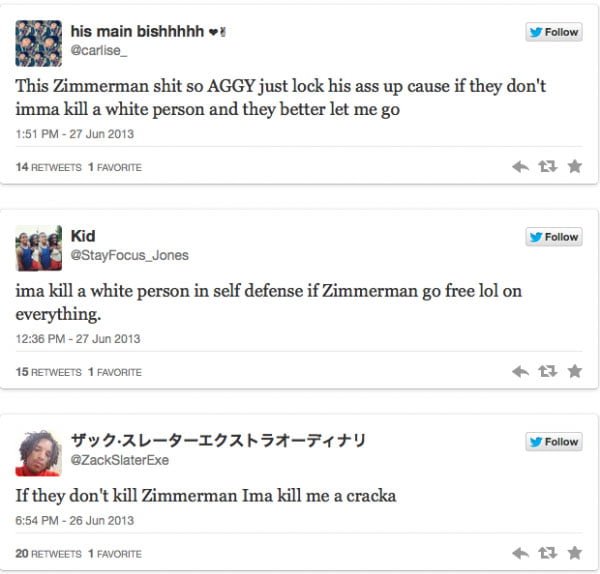
Shabazz, who previously made comments insinuating that he’d like to murder white babies and adults, recently made the shocking claim that he’d “love nothing more than to come home with a cracker’s head in my book bag.” Thousands of tweets and Facebook posts echo Shabazz’s comments, with many users taking to the social networks to proclaim their support for the random killing of whites should George Zimmerman be found innocent.
kill-me-a-cracka
With jury deliberations set to begin as early as Friday, residents in Florida where the trial is taking place, should take note. However, because of the widespread coverage of the case, it’s likely that should civil unrest, riots, or violence break out, it would be a nationwide phenomenon with the potential to randomly target Caucasians and Hispanics all over the United States.
Reports have emerged that New Black Panther Party organizers are alreadytaking steps to bus mobs of people into Florida in the event of an acquittal, so a wave of violence resulting from the Zimmerman verdict is all but guaranteed.  >>more<<  thank you brian

Short URL: http://www.newsnet14.com/?p=126309

Thursday, July 11, 2013

Clarence Page commentary: Blacks need to hold themselves accountable on race

A poll suggests that Americans, including black Americans, tend to think blacks are more racist than whites or Hispanics. I don’t think we are. We only sound like it sometimes.
The poll by the conservative-leaning Rasmussen Reports finds a larger minority of Americans, 37 percent, think most black Americans are racist compared to the 15 percent of respondents who think most white Americans are racist or the 18 percent who think that about Hispanic Americans.
I expected the numbers to fall heavily along racial and partisan lines, and they do. For example, 49 percent of conservatives consider most blacks to be racist compared to only 21 percent of liberals. Considering how many of today’s conservatives tend to hear any racial grievance as “ playing the race card,” I’m not surprised.
What defies the usual stereotypes is the sizeable minority of blacks, 31 percent, who agreed with the 38 percent of whites in the poll who think that most blacks are racist. That’s higher than the 24 percent of blacks (and 10 percent of whites) who think that most whites are racist.
That stereotype-shattering result might suggest that we black folks have some work to do in cleaning up our own prejudices. Understood. But what? The poll offers not a clue.
For starters, it doesn’t define racist, even though there is hardly a more abused, misused and overused word in the English language than the R-word.
Two major misunderstandings make a mess of today’s race debates. One, our racial attitudes are based on our personal experiences and all of our experiences are very different. Two, everybody carries different definitions in their heads of what racism is.
Merriam-Webster’s online dictionary lists two definitions. One is “a belief that race is the primary determinant of human traits and capacities and that racial differences produce an inherent superiority of a particular race.” The other is “racial prejudice or discrimination.”
But there’s at least one other definition, widely believed among black folks, that touched off an uproar after Spike Lee expressed it in a July 1991Playboy magazine interview: “Black people can’t be racist,” he said. ”Racism is an institution.”
Although “black people can be prejudiced,” Lee allowed, we “don’t have the power” to enforce the sweeping institutional racism that perpetuates social, economic and political inequality. Maybe not, I say, but we’re moving up. >>more<<

Wednesday, July 10, 2013

Tuesday, July 9, 2013

Under current US immigration law even anti-Nazi resistance fighters would have been labeled as “terrorists”

Stupid question:  If this was the case that these anti-Nazi resistance fighters are considered terrorists, wouldn’t that make the SPLC, Nazi-hunters, etc,; Terrorist groups?
Seeing how that has allegedly been all listed above and more groups not listed  dream as far as being Anti-Nazi pretty much a form of terrorizing Americans to be able to live under their rights as an American Citizen be considered  of  some kind of terrorist activity?   Why aren’t these people hunted down and their lives made miserable? 


The “Material Support” Problem:
The Jewish Perspective
A Complete Analysis for Policymakers, Legislators,
Community Leaders, and Activists
b y Me l a n i e Ne z e r
“Material Support to Terrorism” -
Definition and Legislative History
For many decades U.S. immigration law has excluded from entry into the country those intending to harm the United States. When enacted in 1952, the
Immigration and Nationality Act (INA)21 stressed the need to bar entry to individuals engaging “in activities prejudicial to the public interest or safety.”
22 As the world changed,so did the INA. In 1990, Congress added a new ground of exclusion relating specifically to terrorist activities.
23 After September 11, Congress passed the PATRIOT Act of 2001, which
greatly expanded INA’s terrorism definitions; one of the many provisions in the act barred any non-citizen who has afforded “material support” to a terrorist or a terrorist organization from entering or remaining in the United States.
24 The REAL ID Act of 2005 further expanded the definition of terrorism.25At the same time, both the PATRIOT Act and the REAL ID Act granted theAdministration the discretionary authority to admit non-citizens who would otherwise be barred from entering the United States because of material support. This discretionary authority may be exercised by the either the Secretary of Homeland Security or the Secretary of State afterconsultation with one another and the Attorney General.26 As it stands today, non-citizens who knowingly commit acts that afford material support either for the commission of terrorist activity or to a terrorist organization may not enter or remain in the United States. According to the text of the INA, “material support” includes, butis not limited to, provision of “[a] safe house, transportation, communications, funds, transfer of funds or other material financial benefit, false documentation or identification, weapons (including chemical, biological, or radiological weapons), explosives, or training.” 27 The term “material” itself is not defined in the statute. The term “terrorist activity” includes acts commonly understood to involve terrorism,such as the hijacking of an airplane or kidnapping. 28 However, it also includes the following: use of an “explosive, firearm, or other weapon or dangerous device (other than for mere personal monetary gain), with intent to endanger,  directly or indirectly, the safety of one or more individuals or to cause substantial damage to property.”  >>MORE<<

Etta Allen, Mother Of Former Va Governor George F Allen, Dies At Age 90


Under Section 212(a)(3)(b) of current federal immigration law even the partisans who supported those who fought Nazis in Germany would have been designated as members of Tier III terrorist groups. How could that be? Well, according to an article in City Pages, “under the law, any group of ‘two or more individuals, whether organized or not, which engages in’ terrorist activity can be labeled a Tier III terrorist group, with ‘terrorist activity’ defined as any use of violence for purposes other than personal enrichment”. Not only that, but there is no publicly available list of Tier III terrorist groups. The article explains that groups are labeled Tier III on a case-by-case basis:
…Under Section 212(a)(3)(b) of federal immigration law, immigrants involved with terrorist groups are not admissable to the United States. But in the wake of 9/11, lawmakers broadly expanded the definition of “terrorist.” That transformed thousands of refugees and asylees already granted protection by the federal government into newly minted “terrorists,” delaying thousands of immigrants’ cases for months and years…
The USA PATRIOT Act created new definitions of “terrorist organizations” and providing “material support” to terrorism. It created two categories of terrorist organizations, labeled Tier I and Tier II. Maintained by the State Department, the list includes organizations like Al-Qaeda, Peru’s Shining Path, Colombia’s FARC, Al-Shabaab, and many others.
But the PATRIOT Act also created a third tier: “undesignated” terrorist organizations. Under the law, any group of “two or more individuals, whether organized or not, which engages in” terrorist activity can be labeled a Tier III terrorist group, with “terrorist activity” defined as any use of violence for purposes other than personal enrichment.
A 2005 bill, the REAL ID Act, broadened the PATRIOT Act’s definition of a “Tier III terrorist organization” to include any organization with a subgroup that engages in “terrorist activity.”
Unlike Tier I and Tier II organizations, there is no publicly available list of Tier III terrorist groups. Groups are labeled Tier III on a case-by-case basis, which is a problem for advocates.  >>more<<


NEW! People of A Thousand Towns Photo Catalog

Short URL: http://www.newsnet14.com/?p=126256

Saturday, July 6, 2013

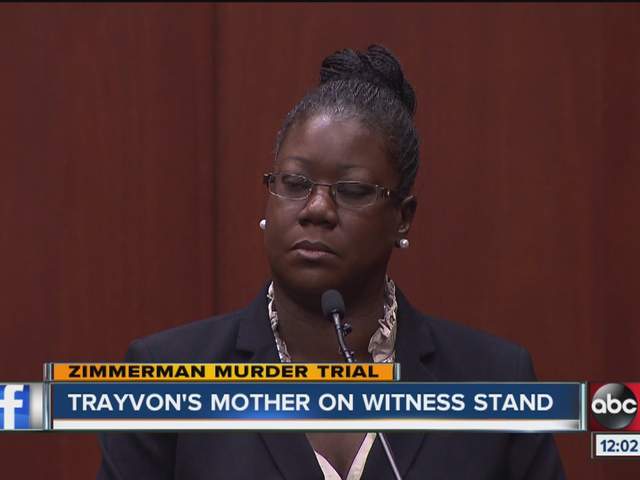
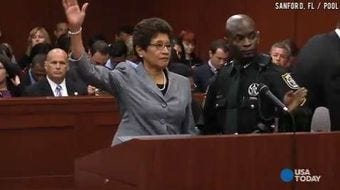
Is this even possible, Martin/Zimmerman mom's allowed to testify after hearing all the testimony?


I don't know how it is permissible for Trayvons mother and Georges to be able to get on the stand bc every trial I know that's not televised witnesses or those who testify aren't allowed in the courtroom, until after they testify so they can't change their story? Just saying.....


USDOJ:

Victim-Witness Program Witness Information


Tips for Testifying
  1. Tell the truth. This is the single most important advice any witness should remember. When you are called to testify, you will first be required to take an oath or affirmation to tell the truth. When you take the oath or affirmation, say "I do" clearly. When you are asked questions, every true fact should be readily admitted. Do not stop to figure out whether your answer will help or hurt either side. Just answer the questions to the best of your memory.
  2. Be prepared. You should know days or weeks ahead of time that you will be testifying. Before you testify, think about the incident and what happened, so that you can recall the details accurately when you are asked in court. If the question is about distances or time, and if your answer is only an estimate, be sure you say it is only an estimate. Beware of suggestions by attorneys as to distances or times when you do not recall the actual time or distance. Do not agree with their estimate unless you independently arrive at the same estimate.
  3. Speak in your own words. Don't try to memorize what you are going to say. Doing so will make your testimony sound rehearsed and unconvincing. Instead, just be yourself. Prior to the trial or hearing, go over in your own mind those matters about which you will be questioned.
  4. Dress neatly. There is no dress code in a courtroom. However, it is important to have a neat appearance, and to dress in a manner that shows respect for the courtroom proceedings. An appearance that seems very casual or overly dressy may distract the jury during the brief time you are on the stand, and they may not concentrate on your testimony. Hats should not be worn in the courtroom.
  5. Avoid distracting mannerisms while testifying.Avoid chewing gum, candy, or other objects that may make you difficult to understand. Present your testimony clearly, slowly, and loud enough so that the juror seated farthest away from you can easily hear and understand everything you say.
  6. Do not speak to jurors or discuss the case outside of the courtroom. Jurors who are or will be sitting on the case in which you are a witness may be present in the same public areas of the courthouse where you will be. For that reason, you should not discuss the case with anyone. Remember, too, that jurors may have an opportunity to observe how you act outside the courtroom. If you see a juror, you are not allowed to speak to the juror, even to say hello.
  7. Conduct yourself in a dignified manner. From the moment you enter the courtroom or courthouse, your behavior should be appropriate to the seriousness of the proceedings. When you are called into court for any reason, be serious and avoid saying anything about the case until you are actually on the witness stand. Also, do not read in the courtroom, unless asked to do so by the judge or the attorneys.
  8. Do not exaggerate or guess. Don't make overly broad statements that you may have to correct. Be particularly careful in responding to a question that begins, "Wouldn't you agree that...?" The explanation should be in your own words. Do not allow an attorney to put words in your mouth. Give positive, definite answers when at all possible. Avoid saying "I think," "I believe," or "In my opinion." If you do not remember certain details, it is best to say that you don't remember. If you don't understand the question, say so. Don't make up an answer.
  9. Expect to be questioned by several people. One of the basic rules in a criminal case is that both sides have a chance to question every witness. Questions asked by both sides have the same goal - to find out what is true. When a witness gives testimony, he or she is first asked some questions by the lawyer who called the witness to the stand. If you have been called by the U.S. Attorney's Office, this attorney is the Assistant United States Attorney (AUSA). This is called the "direct examination." The witness is then questioned by the defense lawyer in "cross examination." Sometimes the process is repeated two or three times to help clear up any confusion. The basic purpose of direct examination is for you to tell the judge and jury what you know about the case. The basic purpose of cross-examination is to raise doubts about the accuracy of your testimony. If you feel you are being doubted in cross-examination, remember that to raise doubt is the defense counsel's job. Try not to take questions personally or be upset by an attorney's questions. Always be courteous, even if the lawyer questioning you appears discourteous. A witness who is angry or upset may appear to be less than objective. Do not appear to be a "wise guy" or you will lose the respect of the judge and the jury. If you are testifying before the grand jury, there will not be a defense attorney present. However, you may be asked questions by members of the grand jury.
  10. Jurors are ordinary people, just like you. Although you are responding to the questions of a lawyer, remember that the questions and answers are really for the jury's benefit. Jurors are the ones who decide the facts of the case. Always speak clearly and loudly, so that every juror can hear you.
  11. Listen carefully to the questions that you are asked. Understand the question (have it repeated, if necessary), then give a thoughtful, considered answer. Do not give an answer without thinking. While answers should not be rushed, neither should there be an unnaturally long delay to a simple question if you know the answer.
  12. Answer the questions verbally. Do not nod your head for a "yes" or "no" answer. Speak out loud, so that the court reporter can hear the answer. For the same reason, try to avoid words like "yah," "nope," and "uh-huh."
  13. Answer only the questions asked. Do not volunteer information which has not actually been asked of you. If you don't understand the question asked by one of the attorneys, ask the attorney to repeat or rephrase the question so that you understand exactly what is being asked.
  14. Answer all questions to the point. If the question cannot be truthfully answered with a simple "yes" or "no," ask to explain your answer. If your answer was not correctly stated, correct it immediately. If your answer was not clear, clarify it immediately. If you realize you have answered incorrectly, say, "May I correct something I said earlier?"
  15. Stick to the facts. The judge and the jury are interested in the facts that you have observed or about which you have personal knowledge. Therefore, don't give your conclusions and opinions, and don't state what someone else told you, unless you are specifically asked. Unless certain, don't say "That's all of the conversation" or "Nothing else happened." Instead, you might say, "That's all I recall" or "That's all I remember happening." It may be that after more thought or another question, you will remember something important.
  16. Mistakes happen. Sometimes, witnesses give inconsistent testimony - something they said before doesn't agree with something they said later. If this happens to you, don't get flustered. Just explain honestly whey you were mistaken. The jury, like the rest of us, understands that people make honest mistakes.
  17. Follow the judge's instructions at all times. Stop instantly when the judge interrupts you, or when an attorney objects to a question, and wait for the judge to tell you to continue.
  18. Don't start to answer a question until the question is finished. If you haven't heard the entire question, you don't really know what you are being asked. In addition, sometimes an attorney may raise an objection to the question being asked. "Objection" is a legal term that means one of the attorneys feels you are being asked an improper kind of question. When you hear a lawyer say "objection," simply stop speaking and wait for the judge to rule on the objection. If the judge decides the question is proper, he or she will overrule the objection. If the judge decides the question is not proper, he or she will sustain the objection. You will be told either by the judge or the attorney whether to go ahead and answer the question. Sometimes the judge and attorneys will need to talk just amongst themselves. A "sidebar" is when the judge and the attorneys meet at the judge's bench to discuss various matters, including technical disputes over the Federal Rules of Evidence. They meet at the judge's bench so that the jury cannot hear their discussion.

  19. Do not talk about your testimony with other witnesses. After a witness has testified in court, he or she should not tell other witnesses what was said during the testimony until after the case is over. Do not ask other witnesses about their testimony, and do not volunteer information about your own. Sometimes an attorney may ask if you have talked to anybody about the case. It is perfectly proper for you to have talked to people before you testified, such as the prosecutor or your family or friends, and you should respond truthfully to this question