Holger G. is seen on Nov. 14 as he is taken to the Federal Court of Justice in Karlsruhe.
By Hubert Gude, Sven Röbel and Holger Stark
Holger G., who was arrested in November, was one of a network of people who allegedly helped the Zwickau neo-Nazi cell, suspected of murdering at least 10 people. Unlike the one surviving member of the cell, he is talking to investigators. His statements provide a chilling insight into the trio’s activities during their time in the underground.
BERLIN (AP) — German prosecutors say police are raiding the homes of four alleged supporters of a neo-Nazi group linked to the killings of nine immigrants and a policewoman over the past decade.
The federal prosecutors’ office said Wednesday the four people are suspected of having provided the far-right group with weapons and, in one case, explosives. They were not identified.
Prosecutors say seven apartments and two office premises are being searched in the eastern states of Saxony and Thuringia and southwestern Baden-Wuerttemberg state.
The alleged founders of the Nationalist Socialist Underground group, Uwe Boehnhardt and Uwe Mundlos, died in an apparent murder-suicide in November.
Despite increasing levels of brutal racially motivated black on white mob violence, many big city prosecutors still absolutely refuse to charge any blacks with hate crimes.
Portland has seen a rash of brutal racially motivated group assaults against random white victims. None of the attackers are being charged with hate crimes despite the fact that the black perpetrators routinely use racial slurs while committing these crime.
Channel 2 Portland is reporting growing outrage over the refusal to prosecute black perpetrators with hate crimes. Watch the left-wing liberal arts college professor explain how black thugs attacking a white victim while screaming racial slurs is not a “hate crime.”
The same exact people claiming that the bus attack was “not a hate” would be screaming for hate crime charges if the races had been reversed.more at source
OK so if they want to look at ‘racial hate crime’ in that sense then they better be dropping a whole bunch of charges on white’s who where alleged attackers on a person of ‘color’ shera~
MARTIN: The FBI reports that about 20 percent of hate crimes are committed by African-Americans. And does that mean anything, or does that information have some bearing on the this in some way? MARK POTOK: Well, the FBI statistics are notoriously shaky, through no fault of their own. It’s a voluntary reporting system. The numbers are known to be extremely weak. That said, I think they are indicative of something. What the numbers show is, as you suggested, is almost 21 percent of hate crimes, according to FBI numbers, are committed by black Americans, who comprise about 13 percent of the population. About 58 percent are committed by whites, who makeup about 80 percent of the population. So the FBI statistics do suggest that blacks commit hate crimes at a somewhat higher level than whites. And that is very possibly true. We really can’t know that because the FBI stats are so incomplete. MARTIN: But what are the – what’s the age of most of the assailants? Are teenagers typical? Are they typically adults? Is there an pattern? POTOK: Yeah, most hate criminals are between the ages of about 13 and 21 -probably more than half of them. MARTIN: And most of the… POTOK: And that is true of all crimes. So it’s not very particular to hate crimes. MARTIN: Now, as you heard me discuss, there’s some sentiment out there – which I have read a lot of on the blogs – that some people feel that stories of black-on-white crime are downplayed. Do you have any thoughts about that? POTOK: Well, I think that, first of all, that sentiment is extremely widespread. I’d say hundreds of thousands, if not millions of Americans think so. And it’s these kinds of cases that are constantly hauled out, you know, on the blogs, on various Web pages and so on to make this case. Sometimes, there is real truth to the complaints. I think that there’s – yeah, I think there’s some truth to the idea that the media, or much of the media does tend to sort of gravitate toward a preferred narratives, or, you know, well-known narratives. You know, wicked whites attack, you know, sort of hapless black victims. You know, that said, a lot of these cases..
Throughout the Famine years, nearly a million Irish arrived in the United States. Famine immigrants were the first big wave of poor refugees ever to arrive in the U.S. and Americans were simply overwhelmed. Upon arrival in America, the Irish found the going to be quite tough. With no one to help them, they immediately settled into the lowest rung of society and waged a daily battle for survival.
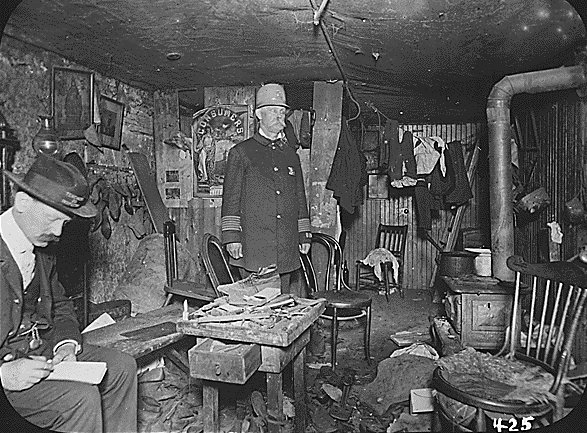
In New York, officials investigate a squalid tenement, 1900.
The roughest welcome of all would be in Boston, Massachusetts, an Anglo-Saxon city with a population of about 115,000. It was a place run by descendants of English Puritans, men who could proudly recite their lineage back to 1620 and the Mayflower ship. Now, some two hundred thirty years later, their city was undergoing nothing short of an unwanted “social revolution” as described by Ephraim Peabody, member of an old Yankee family. In 1847, the first big year of Famine emigration, the city was swamped with 37,000 Irish Catholics arriving by sea and land.
Proper Bostonians pointed and laughed at the first Irish immigrants stepping off ships wearing clothes twenty years out of fashion. They watched as the newly arrived Irishmen settled with their families into enclaves that became exclusively Irish near the Boston waterfront along Batterymarch and Broad Streets, then in the North End section and in East Boston. Irishmen took any unskilled jobs they could find such as cleaning yards and stables, unloading ships, and pushing carts.
There was little Italian emigration to the United States before 1870. However, Italy was now one of the most overcrowded countries in Europe and many began to consider the possibility of leaving Italy to escape low wages and high taxes. Most of these immigrants were from rural communities with very little education. From 1890 to 1900, 655,888 arrived in the United States, of whom two-thirds were men. A survey carried out that most planned to return once they had built up some capital.
Most Italians found unskilled work in America’s cities. There were large colonies in New York, Philadelphia, Chicago,Baltimore and Detroit. From 1900 to 1910 over 2,100,00 arrived. Of these, around 40 per cent eventually returned to Italy.
Willing to work long hours on low wages, the Italians now began to rival the Irish for much of the unskilled work available in industrial areas. This sometimes led to hostilities breaking out between the two groups of workers. The Italians were also recruited into the garment industry and by the outbreak of the First World War had replaced theJews as the main group in the sweated trades.
After the First World War Italians developed a reputation for becoming criminals. This was mainly due to high-profile criminals such as Al Capone, Lucky Luciano, Joe Masseria, Albert Anastasia, Salvadore Marazano, Vito Genoveseand Frank Costello. However, a study in Massachusetts revealed that the Italian-born, who comprised 8.0 per cent of the population of the state, made up only 4.2 per cent of those confined in penal institutions. The US Department of Justice also estimates that less than .0025 percent of Italian Americans have anything to do with organized crime.
During the period 1820 and 1920 over 4,190,000 people emigrated from Italy to the United States. Only Ireland(4,400,000) and Germany (5,500,000) came anywhere near these figures.MORE